Last updated:
The 295-C law in Pakistan is section 295-C of the Pakistan Penal Code 1860, headed "Use of derogatory remarks, etc., in respect of the Holy Prophet". It punishes anyone who "defiles the sacred name of the Holy Prophet Muhammad", directly or indirectly. That can be by spoken or written words, a visible representation, or an imputation, innuendo or insinuation. The printed penalty is "death, or imprisonment for life", and a fine. However, a 1990 Federal Shariat Court ruling, Muhammad Ismail Qureshi v Pakistan, made death the only lawful sentence from 30 April 1991.[1][2] The offence is cognizable and non-bailable. Under section 156-A of the Code of Criminal Procedure, only an officer of Superintendent of Police rank or above may investigate it. A Court of Session tries the case.[3]
In practice, the danger starts long before any verdict. The state has never executed anyone for blasphemy. Yet courts keep passing death sentences, and hundreds of people wait in prison. Mobs have also killed accused people in the street, in police stations and after acquittal.[4] Below we set out the text, the procedure and the related offences. We then give dated case data for 2023 to 2026 and explain how UK and US asylum law treats a person accused under section 295-C.
People accused of blasphemy killed outside the law, 1994-2024 (CSJ)
People accused under blasphemy laws in 2025 (CSJ, via CSW)
Blasphemy prisoners in Pakistan, 25 July 2024 (NCHR)
State executions for blasphemy to date (Home Office, July 2026)
The 295-C law in Pakistan: text and penalty
General Zia-ul-Haq's government added section 295-C through the Criminal Law (Amendment) Act 1986 (Act III of 1986). The President gave assent on 5 October 1986, and the Act appeared in the Gazette on 12 October 1986.[1] The full text reads:
"295-C. Use of derogatory remarks, etc., in respect of the Holy Prophet: Whoever by words, either spoken or written, or by visible representation or by any imputation, innuendo, or insinuation, directly or indirectly, defiles the sacred name of the Holy Prophet Muhammad (peace be upon him) shall be punished with death, or imprisonment for life, and shall also be liable to fine."
Pakistan Penal Code 1860, s 295-C, as inserted by the Criminal Law (Amendment) Act 1986
Three features of the wording matter in every case. First, the section contains no word such as "wilfully" or "intentionally", unlike sections 295-A and 295-B. Second, it does not define "defiles". Third, the words "imputation, innuendo, or insinuation" let a complainant rely on how a remark was understood.[5]
The 1990 Federal Shariat Court ruling
The case is Muhammad Ismail Qureshi v Pakistan, reported as PLD 1991 FSC 10. In it, the Federal Shariat Court held that the words "or imprisonment for life" were repugnant to the injunctions of Islam. The court set 30 April 1991 as the deadline for removing them. Parliament never amended the text. Even so, a later Federal Shariat Court order records two points. The appeal against the ruling failed, and life imprisonment "ceased to have effect" from 30 April 1991.[2] According to the Clooney Foundation for Justice, the court also refused any allowance for repentance or apology. It drew no distinction between Muslims and non-Muslims, or between men and women.[5]
For practitioners: the statute book and some secondary sources still show "death or life imprisonment". The Home Office's July 2026 Christians CPIN table does the same.[4] A refusal letter or a report that relies on that wording understates the exposure. A conviction under section 295-C carries one sentence: death.
How a 295-C case moves: FIR, SP investigation, bail and trial
Most cases under the 295-C law in Pakistan start with a First Information Report (FIR) at a local police station. Because the offence is cognizable, officers can register the FIR and arrest without a warrant. In July 2026, Punjab officials briefed the Senate's Functional Committee on Human Rights. They said police now register an FIR as soon as a complaint arrives, instead of trying informal mediation. They said this reduces vigilante violence.[6] For the accused, however, it also means a formal case exists from the first day.
Section 156-A of the Code of Criminal Procedure came in with a 2005 amendment. It provides that no police officer below the rank of Superintendent of Police (SP) may investigate a 295-C allegation. In practice, sources say the rule is often ignored. In 2024, the National Commission for Human Rights (NCHR) found that FIA cybercrime cases were "not conducted at the Director level". That breached section 156-A.[3][7] Human Rights Watch likewise describes the safeguard as "routinely disregarded".[8]
Bail is the next hurdle. Section 295-C is non-bailable. Moreover, its penalty is far above ten years in prison. For such offences, the Code bars release where there are reasonable grounds to believe the accused is guilty. As a result, many 295-C accused spend years in pre-trial custody.[3] The 1986 Act made the case triable by a Court of Session and required a Muslim judge to preside.[1] Anti-terrorism courts and the cybercrime agency may also take part where a mob attack or online activity is involved.
Appeals then run to the High Court, and any death sentence needs High Court confirmation. In the end, many cases reach the Supreme Court. This chain explains why accused people often wait a decade or more before an acquittal.
Related blasphemy offences: 295, 295-A, 295-B, 298-A to 298-C and PECA
Section 295-C sits in Chapter XV of the Penal Code, "Of Offences Relating to Religion". Police often charge it together with other sections, so the FIR and the charge sheet need careful reading. The colonial sections protect all religions and carry lighter penalties. The sections added between 1980 and 1986 protect Islam only.[4][9]
| Section | Conduct | Added | Penalty |
|---|---|---|---|
| 295 | Injuring or defiling a place of worship of any class | 1860 | Up to 2 years, or fine, or both |
| 295-A | Deliberate and malicious acts to outrage religious feelings of any class | 1927 | Up to 10 years, or fine, or both |
| 295-B | Defiling, damaging or desecrating the Holy Quran | 1982 | Life imprisonment |
| 295-C | Derogatory remarks in respect of the Holy Prophet | 1986 | Death (since 30 April 1991), and fine |
| 298-A | Derogatory remarks in respect of holy personages | 1980 | Up to 3 years, or fine, or both |
| 298-B | Ahmadis using epithets and titles reserved for Muslims | 1984 | Up to 3 years and fine |
| 298-C | Ahmadis "posing as Muslims" or preaching their faith | 1984 | Up to 3 years and fine |
Parliament tried in 2023 to raise the 298-A penalty to between 10 years and life. The Criminal Laws (Amendment) Act 2023 passed both houses. However, President Arif Alvi returned it without assent, so it did not become law.[4]
Online cases add the Prevention of Electronic Crimes Act 2016 (PECA). Section 11 covers anyone who spreads information online that advances, or is likely to advance, interfaith, sectarian or racial hatred. The maximum sentence is seven years. The Prevention of Electronic Crimes (Amendment) Act 2025 came into force with assent on 29 January 2025. It added section 26A on false information and a new social media regulator.[10] The cybercrime wing of the Federal Investigation Agency (FIA) brought most online blasphemy cases. In 2024, the government moved its work to a new National Cyber Crime Investigation Agency. For the social media pattern itself, see our analysis of the new wave of blasphemy accusations in Pakistan.
How many 295-C and blasphemy cases are registered in Pakistan?
Pakistan publishes no single official register of blasphemy cases, so figures differ by source and by what they count. The Centre for Social Justice (CSJ) in Lahore gives the most consistent yearly series of people accused. It counted 329 people in 2023 and 344 in 2024.[11] Of those accused in 2024, 242 were Muslim, 49 Ahmadi, 32 Hindu and 20 Christian.[4] For 2025, Christian Solidarity Worldwide reports a CSJ figure of at least 362. We have not seen the CSJ 2025 report itself, so that number rests on a secondary source.[11]
Official data on section 295-C alone is rare. In July 2026, provincial home secretaries and police gave the Senate committee new figures. They said most of the 333 blasphemy cases registered over five years in the four provinces were fabricated. Punjab reported 116 cases under section 295-C over that period. Sindh reported 29 under 295-C and 96 under 295-B.[6] Officials said personal vendettas and family disputes often lay behind the complaints.
Prison numbers rose fast. The NCHR recorded 11 blasphemy prisoners in 2020 and 213 in 2023. By 25 July 2024 there were 767, of whom 581 were in Punjab.[7] Later, the Human Rights Commission of Pakistan (HRCP) counted 729 blasphemy prisoners in Punjab jails on 17 June 2025. Of these, 679 were still under trial.[4] In September 2024, the UN Committee on the Elimination of Racial Discrimination said it was "alarmed" by the increase. It also criticised the "broad and vague definitions" in sections 295 to 298-C.[4]
The "blasphemy business" and the Islamabad High Court commission
Most people now accused under the 295-C law in Pakistan are young Muslim men, and many cases share one pattern. In January 2024, the Punjab Special Branch wrote a report called "The Blasphemy Business". It described a group that drew young men into sharing blasphemous images online. The group then filed cases, with help from some FIA officials.[12]
The NCHR inquiry then studied 331 prisoners aged 17 to 33, held as of November 2023. Of these, 96 percent were Muslim and 222 had been arrested by the FIA. Most cases began with a complaint from the same private group. Among the 93 prisoners interviewed in depth, 89 percent said a woman using a false name first contacted them. In addition, 68 percent reported torture in custody and 65 percent said they signed or thumb-printed blank papers.[7]
Families went to court. Justice Sardar Ejaz Ishaq Khan of the Islamabad High Court heard 101 petitions. On 15 July 2025, he ordered the federal government to form a commission on these cases. It was to report within four months. On 24 July 2025, however, a division bench suspended that order. The intra-court appeal came from a lawyer whom petitioners named as a leading complainant. The bench said a commission might interfere with pending trials.[13] As of November 2026, we have found no final decision on the appeal. The commission has not been formed. In October 2026, HRCP said the network had still not been investigated.[14]
For an asylum claim, this evidence helps a young Muslim man who says he was set up. It also shows that the state has not fixed the problem.
Death sentences under 295-C, but no state execution
No one has been executed by the state for blasphemy, and the Home Office confirmed this again in July 2026.[4] Even so, trial courts keep sentencing people to death. HRCP recorded at least 15 death sentences for blasphemy in 2025.[14] In January 2025, a Rawalpindi court sentenced four men to death for online posts. In July 2024, a court sentenced Ehsan Shan, a Christian, to death for reposting defaced Quran pages on TikTok. Then, in September 2024, Shagufta Kiran, a Christian woman, received a death sentence over a WhatsApp message.[4][15]
The lack of executions does not mean the sentence is symbolic. A person sentenced under section 295-C lives on death row for years, often in isolation for their own safety. Furthermore, custody is not safe. In September 2024, a police officer shot a blasphemy suspect dead inside a Quetta police station. The NCHR also recorded a death in FIA-linked custody in June 2024.[16] For asylum purposes, the risk covers the whole process. It runs from arrest and years of custody to a likely death sentence and violence outside court.
Mob killings after 295-C and other blasphemy accusations in Pakistan
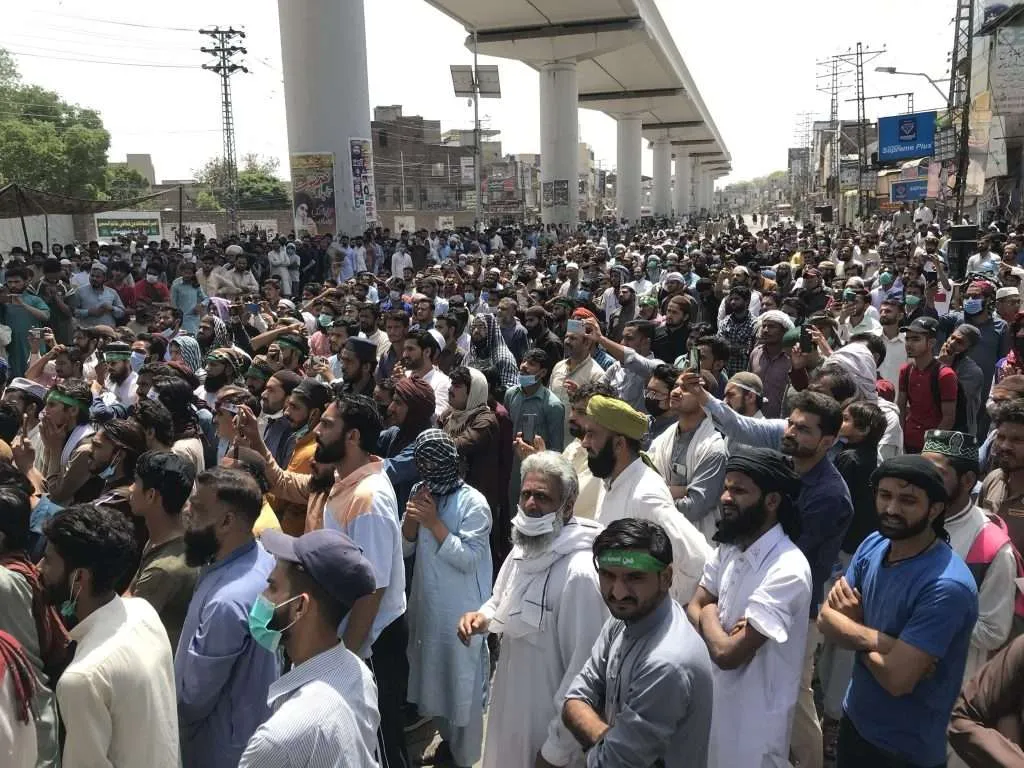
Most blasphemy-related deaths in Pakistan happen outside the law. The CSJ counted 104 people killed extrajudicially after accusations between 1994 and 2024. The Centre for Research and Security Studies counted 89 such killings from 1947 to 2021. Because the two series start in different years, they do not contradict each other.[11] HRCP recorded at least 24 deaths from mob violence in 2024.[14]
| Date | Place | What happened |
|---|---|---|
| 1 Aug 2009 | Gojra, Punjab | Mob burned Christian homes after a Quran desecration rumour; at least seven Christians killed |
| 4 Nov 2014 | Kot Radha Kishan, Punjab | Christian couple Shama and Shahzad Masih beaten and burned in a brick kiln |
| 13 Apr 2017 | Mardan, Khyber Pakhtunkhwa | Student Mashal Khan beaten and shot on his university campus |
| 3 Dec 2021 | Sialkot, Punjab | Sri Lankan factory manager Priyantha Kumara Diyawadana killed by workers; body set on fire |
| 16 Aug 2023 | Jaranwala, Punjab | More than 20 churches and over 80 Christian homes attacked |
| 25 May 2024 | Sargodha, Punjab | Elderly Christian Nazir Masih attacked by a mob; died on 3 June 2024 |
| 20 Jun 2024 | Madyan, Swat | Mob took tourist Muhammad Ismail of Sialkot from police custody, killed him and burned the body; police station set alight |
| Sep 2024 | Quetta and Umerkot | Suspect shot inside a Quetta police station; Dr Shahnawaz Kunbhar killed by Sindh police in what an inquiry called a staged encounter |
Prosecutions after these attacks are uneven. In the Sialkot case, an anti-terrorism court sentenced six men to death and nine to life imprisonment on 18 April 2022.[17] By contrast, in June 2025 an anti-terrorism court acquitted 10 men, including the main suspect, over the Jaranwala arson. Earlier, in March 2024, a court had acquitted the two Christian brothers whose alleged desecration set off the attack. It found that two men with a grudge had framed them.[4][18] Human Rights Watch found in 2025 that almost no one arrested for such attacks had been convicted in recent years.[8]
The pattern is consistent. A rumour spreads through a mosque loudspeaker or social media, and a crowd gathers within hours. Police then arrive late or hand the accused over. In October 2026, a crowd in Sheikhupura district burned the home and pharmacy of a Christian man after a blasphemy claim. More than 35 families fled.[19]
Asia Bibi, Junaid Hafeez and the people who defended them
Asia Bibi
Asia Noreen, known as Asia Bibi, is a Christian farm worker from Sheikhupura district. After a quarrel with Muslim co-workers over drinking water in June 2009, she was accused under section 295-C. A trial court sentenced her to death in November 2010. The Lahore High Court upheld the sentence in October 2014. On 31 October 2018, the Supreme Court acquitted her in Criminal Appeal No. 39-L of 2015. It pointed to contradictions in the witness evidence and a five-day delay in registering the FIR.[20] Tehreek-e-Labbaik Pakistan (TLP) then led nationwide protests. After the Supreme Court dismissed a review petition in January 2019, she left for Canada in May 2019.
Junaid Hafeez
Junaid Hafeez, a lecturer at Bahauddin Zakariya University in Multan, was arrested on 13 March 2013. A Multan court sentenced him to death on 21 December 2019. His appeal has been pending since 2020. On 19 May 2026, Dawn reported that the Lahore High Court had held no substantive hearing for about a year.[21] As of November 2026, we have found no report of a ruling. His first lawyer, Rashid Rehman, was shot dead in his Multan office on 7 May 2014. Weeks earlier, he had been threatened in court for taking the case.[22]
Salmaan Taseer and Shahbaz Bhatti
Punjab Governor Salmaan Taseer visited Asia Bibi in jail and called for reform of the blasphemy law. His own guard, Mumtaz Qadri, shot him dead in Islamabad on 4 January 2011. The Supreme Court upheld Qadri's death sentence on 7 October 2015, and he was hanged in February 2016. Large crowds attended his funeral, and his grave became a shrine. Shahbaz Bhatti, the Christian Federal Minister for Minority Affairs, was killed in Islamabad on 2 March 2011. He had also supported reform.[23] Since then, few politicians have spoken publicly against section 295-C. Judges and defence lawyers in these cases still face threats.[4]
Acquittal and life after a 295-C case
An acquittal under section 295-C rarely ends the danger. Accusers, local clerics and TLP supporters often reject the court's decision. As a result, the accused usually cannot return to the same home or job. Asia Bibi had to leave the country. Shagufta Kausar and Shafqat Emmanuel, a Christian couple, were sentenced to death in 2014 over text messages. The Lahore High Court acquitted them in June 2021, and they then left Pakistan.[24]
Recent acquittals show how long the process can take. In July 2025, the Supreme Court acquitted Anwar Kenneth, a Christian man, after 23 years on death row. In October 2025, a High Court acquitted pastor Zafar Bhatti after 13 years in prison. He died of cardiac arrest days after his release.[4] In January 2026, a Faisalabad court acquitted two Christian nurses charged under section 295-B in 2021.[4]
For a claim, acquittal changes the legal risk, while the social risk often stays. Moreover, an open FIR does not lapse when a person leaves Pakistan. Police can act on it after return. A co-accused or a re-registered case can also bring the person back before a court. The facts that matter are therefore specific. Who is the complainant? Was a cleric or TLP involved? Did the media report the case, and has the family been threatened since?
295-C claims in UK asylum law: CPIN and AK and SK
The Home Office has no separate CPIN on blasphemy. Instead, the issue sits inside the notes on Christians and on Ahmadis. The current note is "Pakistan: Christians and Christian converts", version 6.0, published in July 2026.[4] Its position is that Christians by birth are generally not at risk from the state solely because of their religion. However, some people can show that the state is "actively pursuing a blasphemy allegation against them by bringing formal charges". They may establish a real risk. In that case, protection is unlikely to be available.
The note follows the country guidance in AK and SK (Christians: risk) Pakistan CG [2014] UKUT 569 (IAC).[25] The Upper Tribunal held that the risk of a blasphemy allegation depends on several factors. These include place of residence, education, finances and public religious activity. It added that an allegation "without more" will not usually found a claim. By contrast, an actively pursued charge may show a real risk in the home area and a lack of state protection (paragraphs 244 and 245). Relocation is "normally a viable option". Where a blasphemy accusation is being seriously pursued, however, there is in general no internal relocation alternative (paragraph 247).
Three gaps follow for practitioners. First, the guidance dates from 2014, before the FIA cybercrime cases, the NCHR findings and the suspended Islamabad High Court commission. Second, no CPIN or country guidance case deals directly with Muslims accused of blasphemy, although Muslims are the largest group of accused. Third, AK and SK treats the risk as local. Online cases, by contrast, come from a federal agency and can follow a person across provinces. For Ahmadis, MN and others [2012] UKUT 389 (IAC) remains the country guidance. Section 298-C cases often run alongside 295-C allegations.
295-C claims in US asylum law
In the United States, a person accused under the 295-C law in Pakistan will usually claim on the ground of religion, actual or imputed. The definition is in INA section 101(a)(42)(A). Religion must be "at least one central reason" for the harm under INA section 208(b)(1)(B)(i). Many accusations grow out of land or business disputes. In those cases, the mixed-motive question needs direct evidence. It should show that the accuser used religion as the weapon and that police and courts treat the case as a religious offence.[26]
Prosecution under a general law is not normally persecution. However, a death-only penalty for speech about religion, with no intent element, gives a strong basis to argue that the prosecution itself is persecutory. Withholding of removal and protection under the Convention against Torture (8 CFR 1208.16(c) and 1208.18) are also relevant. For CAT, the question is whether officials would inflict torture or acquiesce in it, including through willful blindness to mob and custodial violence. The NCHR torture findings and the Quetta and Umerkot police killings speak directly to that test.[7][16]
US sources also support the claim. The State Department designated Pakistan a Country of Particular Concern for religious freedom in December 2023. The US Commission on International Religious Freedom recommended redesignation in its 2026 annual report. It said the blasphemy law was used to "punish those deemed to have insulted Islam".[4]
Evidence in a 295-C case
The core document is the FIR. It names the police station, the complainant, the sections charged and the date. A genuine FIR, a charge sheet (challan) and court orders on bail or adjournment show an "actively pursued" case in the AK and SK sense. Home Office caseworkers often challenge these papers. Tribunals assess them under Tanveer Ahmed [2002] UKIAT 00439, looking at each document in the round.[27]
Other evidence fills in the risk outside the courtroom. Examples include local Urdu press reports, mosque announcements and threats to the family. Police reports on mob gatherings and any TLP involvement also help. For a detailed guide to each type, see our page on evidence for Pakistani blasphemy claims. Our Pakistan country conditions report covers the wider position of Ahmadis, Christians, Hindus and Shia Muslims.
What open sources miss and why a Pakistan country expert helps
Open sources on the 295-C law in Pakistan describe trends well. They rarely answer the questions a tribunal asks about one person. For example, is this FIR consistent with how that police station records cases? Was the investigation carried out at SP level, as section 156-A requires? Does the complainant belong to a known group, or to the network described by the Punjab Special Branch? Would a re-registered or dormant case surface at the airport on return?
Those answers depend on Urdu and regional-language sources, court cause lists and local reporting that English-language COI often misses. Our Pakistan expert witness page lists everyone on the panel, and three of them cover this kind of case:
- Mr Zafar Khan is a Pakistani lawyer and legal investigator. According to his profile, he has carried out document verification and identity investigations for the Royal Norwegian Embassy in Islamabad since 2014. He works in Urdu and English. That background suits cases where the FIR, charge sheet or court orders are disputed.
- Khalid Umar Malik is an international journalist who has published thousands of stories on Pakistan and South Asia for Big News Network. His profile covers religious, ethnic and sectarian minorities, including Ahmadis, Christians, Hindus and Shia communities. He is a native speaker of Urdu and Punjabi.
- Dr Huma Farah Amin covers Pakistan within her South Asia expertise and works across all five Refugee Convention grounds. Her profile lists oral testimony before courts and tribunals and verification of country-specific evidence, and she is fluent in Urdu.
An expert report sets out where the material supports the account and where it does not. To instruct one of them, or to compare other specialists, use our find an expert witness page. Timescales are agreed when the instruction is accepted.
Conclusion
The 295-C law in Pakistan punishes defiling the name of the Prophet Muhammad. Since 30 April 1991, death has been the only lawful sentence. The law requires no proof of intent, an SP must investigate, bail is rarely granted, and a Court of Session tries the case. The state has executed no one under it. Nevertheless, accusations reached a new high in 2025, and hundreds of people remain in prison. As of November 2026, the only judicial inquiry into the entrapment network has been suspended since July 2025.
For UK and US practitioners, the task is to show where a client fits. That means a formal charge that is being pursued and a profile that draws mob or police attention. It also means dated evidence that state protection and relocation fail. The 2014 country guidance did not consider the online cases that now make up most accusations. Current, specific evidence therefore carries the most weight.
Footnotes
- Pakistan Penal Code 1860, s 295-C; Criminal Law (Amendment) Act 1986 (Act III of 1986), assented 5 October 1986, Gazette of Pakistan 12 October 1986, including the amendment to Schedule II of the Code of Criminal Procedure 1898 (text reproduced by persecutionofahmadis.org)
- Muhammad Ismail Qureshi v Pakistan PLD 1991 FSC 10; Federal Shariat Court, Shariat Petition No 7-I of 2013, order recording that imprisonment for life under s 295-C ceased to have effect from 30 April 1991 and that the appeal to the Shariat Appellate Bench was dismissed
- Code of Criminal Procedure 1898, s 156-A and Schedule II; Home Office, 'Country Policy and Information Note: Christians and Christian converts, Pakistan' (v6.0, July 2026) paras 9.5.6 and 11.3.4, quoting the Clooney Foundation for Justice (September 2024); National Commission for Human Rights (Pakistan), report on blasphemy cases against young people (October 2024) 3, 15
- Home Office, 'Country Policy and Information Note: Christians and Christian converts, Pakistan' (v6.0, updated 17 July 2026) paras 4.1-4.2, 6.1, 9.5.2-9.5.5, 10.1.3, 11.3.1-11.3.3, 11.4.1-11.4.10, 11.5.4 gov.uk
- Clooney Foundation for Justice, report on blasphemy trials in Pakistan (September 2024), as quoted in Home Office CPIN (July 2026) para 9.5.4
- Morning Star News, 'Majority of Blasphemy Cases in Pakistan "Fabricated," Officials Say' (13 July 2026), reporting the meeting of the Senate Functional Committee on Human Rights on 8 July 2026 morningstarnews.org
- National Commission for Human Rights (Pakistan), inquiry report on the entrapment of young people in blasphemy cases (October 2024, with update of 25 July 2024) 2-3, 14-16 nchr.gov.pk
- Human Rights Watch, report on the abuse of Pakistan's blasphemy laws (July 2025), as quoted in Home Office CPIN (July 2026) paras 11.5.1-11.5.2
- Pakistan Penal Code 1860, ch XV, ss 295-298-C; Anti-Islamic Activities of the Quadiani Group, Lahori Group and Ahmadis (Prohibition and Punishment) Ordinance 1984 (Ordinance XX of 1984)
- Prevention of Electronic Crimes Act 2016, s 11; Prevention of Electronic Crimes (Amendment) Act 2025, s 26A (assented 29 January 2025); Home Office CPIN (July 2026) para 11.3.7; The Express Tribune, 'FIA cybercrime wing rendered defunct' (4 May 2024)
- Centre for Social Justice, 'Human Rights Observer 2025' (16 April 2025), as reported in Dawn, '70pc suspects in blasphemy cases last year were Muslims' (18 April 2025); Christian Solidarity Worldwide, 'General Briefing: Pakistan' (8 September 2026); Centre for Research and Security Studies, 'Blasphemy Cases in Pakistan: 1947 to 2021' (January 2022)
- Punjab Special Branch, 'The Blasphemy Business' (24 January 2024), as reported in Morning Star News, 'Christians, Others Entrapped in Blasphemy Charges, Report Says' (5 November 2024)
- Geo News, 'IHC halts implementation of order to form blasphemy law commission' (24 July 2025) geo.tv; Dawn, 'Commission on blasphemy claims stayed over "interference" fears' (30 July 2025); Home Office CPIN (July 2026) para 11.5.3
- Human Rights Commission of Pakistan, 'State of Human Rights in 2025' (launched 4 May 2026); HRCP, 'State of Human Rights in 2024' (April 2025); HRCP, 'Sanctuary Denied: Freedom of religion or belief in 2025/26' (October 2026), as reported by Asia News Network (16 October 2026)
- Radio Free Europe/Radio Liberty, 'Pakistani court sentences four to death for blasphemous online posts' (January 2025); Center for the Study of Organized Hate, report of August 2025, as quoted in Home Office CPIN (July 2026) para 11.4.3
- Amnesty International, 'As Good As Dead: The Impact of the Blasphemy Laws in Pakistan' (December 2016) (Gojra and Kot Radha Kishan); Anti-Terrorism Court Haripur, judgment in the Mashal Khan murder case (February 2018); CLAAS-UK, 'Suspects in Sargodha mob attack granted bail' (24 June 2024); The Friday Times, 'Tourist lynched in Swat after being accused of blasphemy' (21 June 2024); Christian Solidarity Worldwide, press release on the killing of Abdul Ali in Quetta (12 September 2024); Dawn, report on the Sindh inquiry into the killing of Dr Shahnawaz Kunbhar (September 2024); NCHR (n 7) 16
- Dawn, 'Priyantha Kumara lynching: ATC awards death sentence to 6, life imprisonment to 9' (18 April 2022) dawn.com
- CLAAS-UK, '10 acquitted in Jaranwala church arson case' (5 June 2025); Christian Solidarity Worldwide, reporting on the Jaranwala attacks (August 2023)
- International Christian Concern, 'Mob burns Christian man's home, pharmacy over blasphemy allegation' (13 October 2026)
- Supreme Court of Pakistan, Mst Asia Bibi v The State, Criminal Appeal No 39-L of 2015, judgment announced 31 October 2018; review petition dismissed 29 January 2019
- Dawn, report on the deferral of Junaid Hafeez's appeal in the Lahore High Court (19 May 2026) dawn.com
- Human Rights Watch, statement on the killing of lawyer Rashid Rehman in Multan (May 2014)
- Supreme Court of Pakistan, Malik Muhammad Mumtaz Qadri v The State, judgment of 7 October 2015; Human Rights Watch, statement on the killing of Shahbaz Bhatti (2 March 2011)
- Reuters, report on the Lahore High Court acquittal of Shagufta Kausar and Shafqat Emmanuel (3 June 2021)
- AK and SK (Christians: risk) Pakistan CG [2014] UKUT 569 (IAC), paras 227, 243-247 bailii.org; MN and others (Ahmadis: country conditions: risk) Pakistan CG [2012] UKUT 389 (IAC)
- Immigration and Nationality Act ss 101(a)(42)(A), 208(b)(1)(B)(i), 241(b)(3) (8 USC 1101, 1158, 1231); 8 CFR 1208.16(c), 1208.18(a)
- Tanveer Ahmed [2002] UKIAT 00439 (starred)
Sources
- Home Office, Country Policy and Information Note: Christians and Christian converts, Pakistan (v6.0), July 2026
- Upper Tribunal, AK and SK (Christians: risk) Pakistan CG [2014] UKUT 569 (IAC), 15 December 2014
- National Commission for Human Rights (Pakistan), Inquiry report on blasphemy cases against young people, October 2024
- Pakistan Penal Code 1860, ss 295 to 298-C; Code of Criminal Procedure 1898, s 156-A and Schedule II; Prevention of Electronic Crimes Act 2016, s 11
- Federal Shariat Court, Muhammad Ismail Qureshi v Pakistan, PLD 1991 FSC 10
- Human Rights Commission of Pakistan, State of Human Rights in 2025, May 2026
- Morning Star News, Majority of Blasphemy Cases in Pakistan "Fabricated," Officials Say, 13 July 2026
- Geo News, IHC halts implementation of order to form blasphemy law commission, 24 July 2025
- Amnesty International, As Good As Dead: The Impact of the Blasphemy Laws in Pakistan, December 2016
- International Commission of Jurists, On Trial: The Implementation of Pakistan's Blasphemy Laws, November 2015
Need an expert witness report for your case?
Our country experts provide independent reports for asylum and immigration cases in the UK, US, Canada, and EU.
Order an expert witness report |
Find a country expert witness |
About our expert team