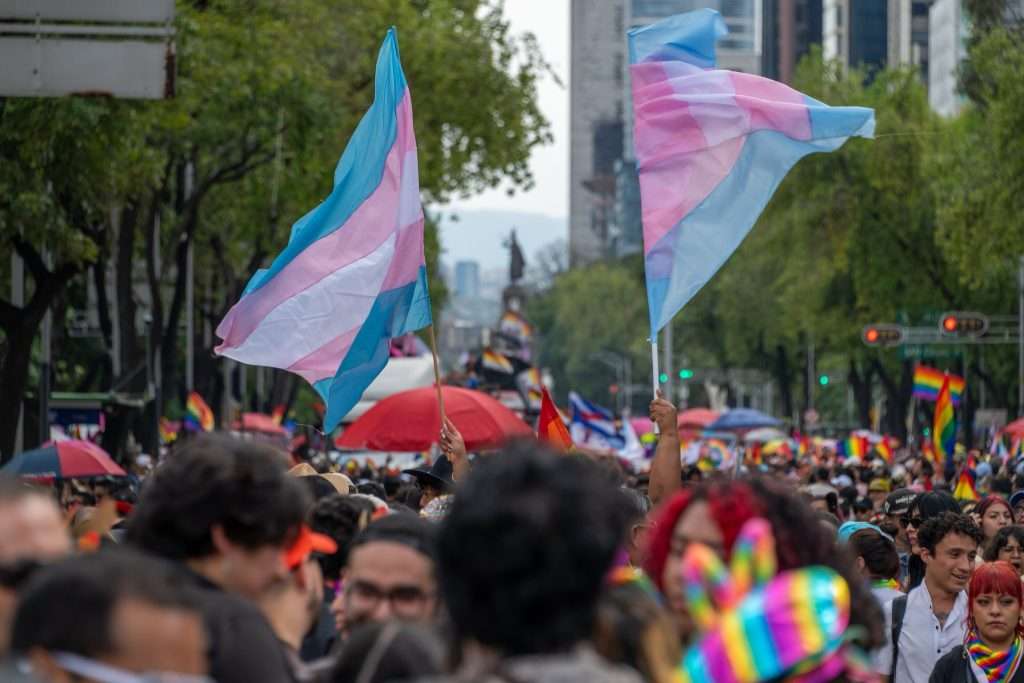
Photo: Bandera Trans en la Marcha del Orgullo LGBT CDMX 2025 Reforma - Omar David Sandoval Sida
Trans women in Mexico were the victims in 35 of the 60 killings of LGBT+ people that the Mexico City organisation Letra Ese recorded in 2025, or 58 percent.[1] In the first months of 2026, the share rose again: 17 of 24 victims were trans women.[2] This guide looks only at trans women. It does not repeat the general story of LGBT rights in Mexico. Instead, it answers the questions that decide a trans woman's asylum case. Who kills and abuses trans women? Do the police protect them or attack them? Which states still refuse to recognise their gender? And is Mexico City a safe place to relocate?
However, the data on the last question cut against a common assumption. In 2024, Mexico City recorded more killings of LGBT+ people than any other state, and most of the victims were trans women.[3] Below, we set out the data year by year, the law state by state, and the US and UK case law that applies. Every figure is dated, because the numbers change each year.
Trans women killed in Mexico in 2025, out of 60 LGBT+ victims (Letra Ese, May 2026)
LGBT+ victims in early 2026 who were trans women (Letra Ese, to 17 May 2026)
LGBT+ homicides in Mexico City in 2024, the highest of any state; 11 were trans women (Letra Ese)
People aged 15+ in Mexico who identify as trans or gender-diverse (INEGI, ENDISEG 2021)
Trans women in Mexico: killings by year, 2019 to 2026
Killings of trans women in Mexico follow a clear pattern in the civil society data. In every recent year, trans women are the largest single group of victims, although they are a small part of the LGBT+ population. According to INEGI's 2021 National Survey on Sexual and Gender Diversity (ENDISEG), about 909,000 people aged 15 and over identify as trans or gender-diverse. That is 0.9 percent of the adult population, compared with 4.6 million people who identify as lesbian, gay or bisexual.[4]
Mexico has no official register of hate crimes against LGBT+ people. As a result, the main yearly series comes from Letra Ese, which collects cases from the press, social media and local groups. The table below combines its figures as published in its reports and as cited by Mexico's National Human Rights Commission (CNDH).
| Year | LGBT+ people killed | Of whom trans women | Source |
|---|---|---|---|
| 2019 | 117 | not separated | Letra Ese, cited by CNDH |
| 2020 | 79 | not separated | Letra Ese, cited by CNDH |
| 2021 | 78 | not separated | Letra Ese, cited by CNDH |
| 2022 | 87 | 48 | Letra Ese |
| 2023 | 66 | 43 | Letra Ese |
| 2024 | 80 | 55 | Letra Ese |
| 2025 | 60 | 35 | Letra Ese |
| 2026 (to mid-May) | 24 | 17 | Letra Ese |
For the earlier years, the CNDH, citing Letra Ese, states that trans women made up 55.2 percent of the victims across 2019 to 2022.[5] In the same recommendation, it calls Mexico the second most dangerous country in the world for trans people, again based on Letra Ese data.
Why the 2025 fall does not mean safer conditions
The drop from 55 trans victims in 2024 to 35 in 2025 is real in the data. However, Letra Ese itself warned against reading it as a lasting improvement.[2] Moreover, the share of trans women among all victims stayed close to 60 percent, and it rose to about 71 percent in early 2026. Therefore, a lawyer facing a refusal that relies on the 2025 drop should point to both facts.
Other monitors count differently. For example, the Observatorio de Crímenes LGBTI+ en México recorded 115 cases in 2025: 59 killings, 34 disappearances, 16 attacks and 6 suicides. Trans women were 33 of the 59 people killed.[6] In addition, its state breakdown for 2025 put Baja California first (7 cases), then Mexico City (6) and Guanajuato (5). A separate monitor run by Fundación Arcoíris recorded 97 killings and 47 disappearances of LGBT+ people in 2024.[1] The figures differ. Even so, every series puts trans women at the centre of the lethal violence.
How trans women are killed
The methods also point to targeted violence rather than random crime. In particular, the CNDH, using Letra Ese data, found that 38 percent of trans victims were shot and 20 percent were stabbed, followed by beatings (9 percent) and strangling (4 percent).[5] In 2024, Letra Ese counted firearms in 34 of the 80 LGBT+ killings.[3] Moreover, activists who track the cases describe cruelty, torture and sexual violence in many of them.[7]
Who is at risk and how trans women are identified
The risk for trans women in Mexico depends largely on visibility. For example, a trans woman who cannot hide her gender identity in the street, at a checkpoint or at work is exposed every day. In 2024, Agencia Presentes reported that most victims of that year's transfemicides were sex workers living in precarious conditions.[7] However, the same report also named other profiles. Two victims, Samantha Fonseca and Miriam Ríos, ran for public office in the 2024 elections. Others included a 16-year-old girl killed in Mexico City and a Honduran trans migrant killed in Chihuahua.
In practice, five groups face the highest risk:
- Trans women in street sex work, who are exposed to clients, pimps, criminal groups that charge a "fee" to work a corner, and police.
- Trans women whose documents do not match their appearance, mainly in states without a gender recognition procedure. Every police stop or job application outs them.
- Trans activists and candidates, whose public profile makes them targets.
- Young trans women expelled from their family home and living without support.
- Trans women with HIV, who need regular treatment and face discrimination in health services.
In most cases, identification is not in doubt. Unlike a gay man, a trans woman is often identified by appearance alone. In Avendano-Hernandez v Lynch, armed police at a roadside checkpoint in Oaxaca insulted a trans woman as she walked past. They then forced her into their truck, beat her and raped her.[8] For this reason, a refusal that says a claimant could "live discreetly" usually misreads how risk works for trans women.
Police abuse of trans women in Mexico: the state as perpetrator
Police are often part of the risk for trans women in Mexico. The US State Department's 2023 report on Mexico, for instance, recorded civil society claims that police "routinely" mistreated LGBTQI+ people in custody. It also found that the government did not always investigate and punish those complicit in abuses, "especially outside Mexico City".[9] Similarly, the CNDH's 2024 recommendation on the trans population describes the history behind this. In the former Federal District, police pursued trans women to extort them, beat them, jail them or make them disappear.[5]
This matters in law because of Avendano-Hernandez. In that case, the Ninth Circuit held that rape by police and soldiers who were on duty and in uniform was torture by public officials. The court rejected the government's argument that they were "rogue or corrupt" officers. It also held that a claimant does not need to show that higher-level officials would approve the torture.[8] Therefore, where the claimant's abusers were police, the question of state protection largely answers itself. Our article on police who work for the cartels in Mexico explains the wider pattern of police collusion.
In addition, impunity adds to the risk. In 2024, only three of the eleven killings of trans women in Mexico City were investigated under the femicide protocol, according to Agencia Presentes.[7] Nationally, by comparison, only about four of every 100 crimes are investigated, according to México Evalúa figures cited by Agencia Presentes.[10]
Cartels, sex work and extortion of trans women
Trans women in Mexico who do street sex work operate in areas that criminal groups control. In May 2026, an Animal Político investigation reported that the Unión Tepito and the Tláhuac Cartel charge sex workers fees in parts of Mexico City, including the Zona Rosa and Puente de Alvarado. It placed the Northeast Cartel in Monterrey's sex-work corridors and the CJNG in Guadalajara's.[11] As a result, this "cobro de piso" links the risk to the same groups that extort shop owners. Consequently, a killing may be motivated by prejudice, by extortion, or by both. For this reason, Letra Ese counts killings that are "presumed" to be linked to prejudice.[1]
Mexican law now recognises this link directly. In August 2024, Mexico City added article 148 Ter to its Penal Code, which creates the crime of transfemicide. The article raises the sentence by up to a third when the killing takes place "in the context of sex work" or involves sexual exploitation or trafficking.[12] In other words, Mexico City's own legislators treated sex work as a recognised risk factor for trans women.
For asylum purposes, mixed motives do not defeat a claim. In the US, the claimant must show that her gender identity was "one central reason" for the harm, under INA § 208(b)(1)(B)(i). In the UK, by contrast, it must be an effective cause. Therefore, a cartel that targets a trans woman both for money and because of her gender identity can meet both tests. However, the claim needs evidence on the local group, its control of the area and its treatment of trans sex workers.
Legal recognition in Mexico: a state-by-state patchwork
Mexico's federal laws protect trans women on paper. In practice, however, the most important rights depend on the state. The table below sets out the main measures and their limits.
| Measure | What it does | Limit |
|---|---|---|
| Administrative gender recognition | Lets an adult change name and sex on the birth certificate without a court case | State law; in 2023 the State Department counted 20 states, and HRW counted 22 of 32 in March 2025 |
| Federal Penal Code, article 209 Quintus (7 June 2024) | Bans conversion practices; 2 to 6 years in prison, doubled for minors | Too recent for published conviction data; we found none as of November 2026 |
| Mexico City Penal Code, article 148 Ter (23 August 2024) | Creates transfemicide; 35 to 70 years in prison | Applies only in Mexico City |
| Mexico City Penal Code, article 138 VIII | Hate as an aggravating factor, including "self-perceived gender identity" and gender expression | Only in Mexico City; many state codes cover sexual orientation only |
| Supreme Court ruling, 29 February 2024 | Killings of trans women must be treated as femicides | No federal crime of transfemicide; most states have not legislated |
Gender recognition
Human Rights Watch's state map, published in March 2025, found that 22 of Mexico's 32 states had an administrative procedure for legal gender recognition. Of these, only seven extended it to children and adolescents, and only three recognised non-binary identities. HRW listed Aguascalientes, Chiapas, Durango, Querétaro, Tabasco and Tamaulipas among the states with no procedure.[13] By contrast, Mexico City first allowed changes to the name and sex on a birth certificate in 2004. As the Ninth Circuit noted in 2015, this came through an amendment to its Civil Code.[8]
For a claimant, therefore, the home state matters. For example, a trans woman from Tamaulipas or Chiapas may hold a birth certificate and voter card that show a male name. Consequently, every identity check outs her. So a lawyer should check which state issued the claimant's documents and whether she could change them there.
Conversion practices and transfemicide laws
On 7 June 2024, Mexico published a decree in the Official Gazette (DOF) adding article 209 Quintus to the Federal Penal Code. It punishes anyone who carries out or pays for practices that try to suppress a person's sexual orientation or gender identity, with two to six years in prison. Moreover, the penalty doubles where the victim is under 18.[14] The State Department's 2023 report cited INEGI data showing that 14 percent of trans people had been subjected to conversion practices.[9]
Transfemicide is now a separate crime in Mexico City, under the "Ley Paola Buenrostro". The law is named after Paola Buenrostro, a trans sex worker killed in 2016.[12] Nayarit's congress approved a similar reform in March 2024.[10] In addition, on 29 February 2024 the Supreme Court (SCJN) held that murdered trans women must be treated as victims of femicide.[10] The same day, the CNDH issued Recommendation 42/2024, which found that the lack of harmonised laws violates the rights of trans people.[5] As of March 2024, 13 state penal codes treated hatred based on "sexual preference" as an aggravating factor in homicide, but none applied it to gender identity.[10]
These laws are relevant evidence. However, they are not proof of protection. In Avendano-Hernandez, the Ninth Circuit held that the Board of Immigration Appeals erred in assuming that new anti-discrimination laws had made life safer for trans women in Mexico.[8]
Is Mexico City a safe place to relocate for trans women?
Refusals of claims by trans women from Mexico often propose relocation to Mexico City. The argument is that the capital has the strongest laws, a large LGBT+ community and a prosecutors' sub-unit for transfemicide cases.[7] ENDISEG 2021 counted about 311,000 LGBTI+ adults in Mexico City.[4] The data, however, point the other way.
- In 2024, Mexico City recorded 17 LGBT+ homicides, more than any other state. Eleven of the victims were trans women. It was the first time the capital ranked first.[3]
- The Centro de Apoyo a las Identidades Trans (CAIT) counted 10 transfemicides in Mexico City in 2024 and 53 between 2007 and 2024.[3]
- Only three of the eleven 2024 killings of trans women in the capital were investigated under the femicide protocol.[7]
- In 2025, Mexico City was still second nationally, with 6 cases in the Observatorio de Crímenes LGBTI+ count.[6]
This pattern is not new. In 2015, the Ninth Circuit noted that Mexico's highest number of hate crimes in 2010 took place in Mexico City. That is the city "where arguably the most efforts have been made" to protect sexual minorities.[8] In fact, the claimant in that case had already moved to Mexico City at 16. There, customers at the nightclub where she worked harassed her and once physically attacked her.
The legal test for relocation
In the UK, paragraph 339O of the Immigration Rules applies. The test is whether relocation would be "unduly harsh", under Januzi v SSHD [2006] UKHL 5 and AH (Sudan) v SSHD [2007] UKHL 49.[15] In the US, 8 C.F.R. § 1208.13(b)(3) lists the factors, including social and cultural constraints such as gender and health. Where the persecutor is the government, including the police, relocation is presumed unreasonable.[16]
For a trans woman, the practical questions are specific. First, whether she can rent a room with documents that show a male name. Second, whether she can find work outside sex work. Third, whether she can get hormones and HIV treatment. Finally, whether the people who targeted her, such as a cartel cell, her family or the police, could find her through networks in the capital. Under HJ (Iran) v SSHD [2010] UKSC 31, she cannot be expected to hide her identity to stay safe.[17] In any event, most trans women cannot hide it. Similarly, in Bringas-Rodriguez, the en banc Ninth Circuit told the agency to consider the claimant's HIV diagnosis when it looked again at relocation.[18]
What the sources say about trans women in Mexico
International and national bodies agree on the core facts about trans women in Mexico, though their reporting has changed since 2024.
Inter-American Commission on Human Rights (IACHR). On 29 August 2024, in press release 197/24, the IACHR called on federal and local authorities to do more to prevent and punish violence against trans people. Press reports of the release cited at least 36 killings of trans women since January 2024.[19] The Commission also warned that a lack of thorough investigation can lead to impunity.
CNDH. Recommendation 42/2024 found violations of the rights of trans people to health, work, identity, equality and access to justice because state laws are not harmonised. Between December 2010 and December 2023, trans people filed 52 percent of the LGBT+ complaints the CNDH received.[5]
US State Department. The 2023 report on Mexico, published in April 2024, is the last edition with a full LGBTQI+ section.[9] The 2024 reports, released in August 2025, removed that section for all countries.[20] As a result, US immigration judges may see less official material on trans women than in past years. Lawyers should therefore file the 2023 report and explain why later editions are silent.
UK Home Office. As of 5 November 2026, the Home Office has not published a Country Policy and Information Note (CPIN) on Mexico on any topic.[21] UK decision-makers therefore apply the general Home Office guidance on gender identity claims and rely on whatever country evidence the parties file. This gap makes independent country evidence more important in UK appeals.
What this means for an asylum claim by a trans woman from Mexico
A claim by a trans woman from Mexico usually turns on four questions: the protected ground, the level of harm, state protection and relocation.
Protected ground
Trans women form a particular social group in both jurisdictions. In the US, Hernandez-Montiel v INS, 225 F.3d 1084 (9th Cir. 2000), recognised a group of "gay men with female sexual identities in Mexico".[22] Later, Avendano-Hernandez also made clear that gender identity and sexual orientation are distinct, and that a judge must not confuse them.[8] Our guide to the particular social group ground explains how courts define such groups. In the UK, the Refugee Convention, Article 1A(2), and HJ (Iran) apply. For claims made on or after 28 June 2022, section 32 of the Nationality and Borders Act 2022 applies. Under it, the claimant must prove her gender identity on the balance of probabilities.
Harm and state protection
Rape and beatings by police meet the threshold for persecution and, in the US, for torture under the Convention Against Torture (CAT). In Avendano-Hernandez, a criminal conviction barred the claimant from withholding of removal. Even so, she won CAT deferral because of past torture by officials and unrebutted country evidence.[8]
Where the abusers were private actors, the claimant must show that the state is unable or unwilling to protect her. In Bringas-Rodriguez v Sessions, 850 F.3d 1051 (9th Cir. 2017) (en banc), a gay man from Veracruz had never reported his abuse. Nevertheless, the court held that his credible evidence that reporting would be futile and dangerous was enough. In doing so, it overruled earlier case law that treated a failure to report as a gap in the evidence.[18] Our article on claims without a Mexican police report covers this point in more detail.
Relocation
As shown above, Mexico City is not a safe default for trans women from Mexico. Instead, the claimant's documents, health needs, work options and the reach of her persecutors decide the question. In particular, where police were the abusers, the US presumption against relocation applies.
Evidence that works in Mexican trans asylum cases
The strongest claims by trans women from Mexico combine personal evidence with local country evidence. In our experience, the following types of evidence are most useful:
- Identity documents: birth certificate, voter card (INE) and any record of a name change, with an explanation of whether her home state allows administrative recognition.
- Medical evidence: records of hormone treatment, HIV care, and injuries from past attacks.
- Psychological evidence: a report on trauma, which also helps explain gaps or delays in her account.
- Witness statements: from friends, partners or trans support groups in Mexico who know her history.
- Local data: Letra Ese and Observatorio figures for her state and city, and press reports of killings of trans women there.
- Evidence on the police: reports of police abuse in her municipality, and why she did not or could not report.
- Evidence on the criminal group: which group controls the area where she worked, and whether it charges trans sex workers.
In addition, the evidence should answer the relocation point directly. For example, a list of Mexico City killings in 2024 and 2025 is more persuasive than a general statement that the capital is dangerous.
What open sources miss and why a country expert is needed
Open sources on trans women in Mexico have real gaps. First, there is no official register, so every figure comes from civil society monitors that count from press reports. Their totals differ. For 2025, Letra Ese counted 60 killings and the Observatorio de Crímenes LGBTI+ counted 59, while another monitor counted 97 killings for 2024.[1][6] As a result, a decision-maker may treat that spread as a reason to doubt all of them.
Second, the data probably undercount. When a victim is recorded under her birth name and as a man, her death does not enter a trans count. Mexico City's 2024 reform recognised one form of this problem. A new paragraph in article 118 of its Civil Code lets a trans person's "social family" register her death where relatives refuse or would erase her identity.[12] Third, state-level data are thin. For instance, a national figure says little about a small town in Veracruz or a neighbourhood in Tijuana. Fourth, official reporting has shrunk. In particular, the State Department removed its LGBTQI+ section in 2025, and the Home Office has no Mexico CPIN at all.
A country expert can fill these gaps. Specifically, an expert can explain why the monitors differ and which figures are reliable. The expert can also assess the claimant's home state, its gender recognition rules and its police, and test whether a named criminal group can reach her in Mexico City. Moreover, courts have relied on this kind of evidence before. In Avendano-Hernandez, the Ninth Circuit quoted an expert declaration on this point. The expert explained that new legal protections had made the situation of LGBT people in Mexico "increasingly more perilous", because the public and the authorities reacted against them.[8]
An expert report must stay independent and within the expert's field. It cannot promise an outcome. To instruct an expert, see our Mexico country expert reports page or browse the expert witness directory.
Conclusion: trans women in Mexico and the protection gap
Civil society data show that trans women in Mexico remain the main victims of lethal anti-LGBT+ violence. They made up 58 percent of victims in 2025 and about 71 percent in early 2026. In addition, the police are often abusers rather than protectors. Moreover, gender recognition still depends on the state, and Mexico City, the usual relocation option, recorded the most LGBT+ killings of any state in 2024. For lawyers, the first task is to separate the claimant's gender identity from sexual orientation. The second is to show why the new laws do not protect her in practice. The third is to answer the Mexico City argument with local, dated evidence.
Footnotes
- Elizabeth Hernández, 'Mujeres trans concentran el mayor riesgo de violencia letal LGBTIQ+ en México' La Razón (18 May 2026), reporting Letra Ese data for 2022 to 2025 and Fundación Arcoíris data for 2024 link
- 'México sigue sin registro oficial de crímenes de odio contra personas LGBT' El Imparcial (EFE, 17 May 2026), quoting Samuel Jair Martínez of Letra Ese link
- Jonathan Castro, 'Lidera CDMX en homicidios en contra de personas LGBTTTIQ+' La Razón (27 June 2025), reporting Letra Ese, Las dinámicas de la violencia por prejuicio: homicidios de personas LGBT+ en México 2024, and CAIT data link
- INEGI, 'Encuesta Nacional sobre Diversidad Sexual y de Género (ENDISEG) 2021: resultados' (press release, 2022) link
- Comisión Nacional de los Derechos Humanos, Recomendación No. 42/2024 sobre la población trans por la falta de armonización legislativa (29 February 2024) paras 52-53, 142, 146 link
- 'Exponen 115 crímenes de odio contra la comunidad LGBT en 2025' La Crónica de Hoy (4 July 2026), reporting Observatorio de Crímenes LGBTI+ en México, Informe 2025. Violencias que persisten link
- Geo González, 'Mexico: What do the more than 50 transfemicides so far in 2024 tell us?' Agencia Presentes (5 September 2024) link
- Avendano-Hernandez v Lynch, 800 F.3d 1072 (9th Cir. 2015) link
- US Department of State, '2023 Country Reports on Human Rights Practices: Mexico' (April 2024) s 6 link
- 'Los asesinatos de mujeres trans son feminicidios, dice la Corte de México y la CNDH' Agencia Presentes (21 March 2024) link
- Juan Hernández, 'Del CJNG a la Unión Tepito: las organizaciones criminales que dominan los corredores de prostitución rumbo al Mundial 2026' La Crónica de Hoy (25 May 2026), reporting an investigation by Víctor Sánchez for Animal Político link
- Decreto por el que se adiciona el artículo 148 Ter al Código Penal para el Distrito Federal y un párrafo segundo al artículo 118 del Código Civil para el Distrito Federal, Gaceta Oficial de la Ciudad de México (23 August 2024) 3-6 link
- Human Rights Watch, 'Reconocimiento legal de género en México' (state map, March 2025) and Alejandro Gómez López, 'Los derechos trans en México: avances y desafíos' (31 March 2025) link
- Decreto por el que se adiciona un artículo 209 Quintus al Código Penal Federal y un artículo 465 Ter a la Ley General de Salud, Diario Oficial de la Federación (7 June 2024) link
- Januzi v Secretary of State for the Home Department [2006] UKHL 5; Secretary of State for the Home Department v AH (Sudan) [2007] UKHL 49; Immigration Rules, para 339O
- 8 C.F.R. § 1208.13(b)(3); see also 8 C.F.R. § 1208.18(a)(1) and (a)(7) on torture by or with the acquiescence of public officials
- HJ (Iran) and HT (Cameroon) v Secretary of State for the Home Department [2010] UKSC 31
- Bringas-Rodriguez v Sessions, 850 F.3d 1051 (9th Cir. 2017) (en banc) link
- Inter-American Commission on Human Rights, 'México: autoridades federales y locales deben redoblar sus esfuerzos para prevenir y sancionar actos de violencia contra personas trans' (Press Release 197/24, 29 August 2024); figure of 36 killings as reported in 'México registra 36 asesinatos de mujeres trans en 2024' El Imparcial (30 August 2024)
- 'LGBTQ people erased from State Department's 2024 human rights report' Washington Blade (12 August 2025) link
- Home Office, 'Country policy and information notes' (GOV.UK collection, checked 5 November 2026; no Mexico entry) link
- Hernandez-Montiel v INS, 225 F.3d 1084 (9th Cir. 2000)
Sources
- Letra Ese, Observatorio de Crímenes de Odio, annual reports on killings of LGBT+ people in Mexico (2023-2026), as reported in La Razón, May 2026
- Comisión Nacional de los Derechos Humanos, Recomendación 42/2024 on the trans population, 29 February 2024
- INEGI, ENDISEG 2021 results, 2022
- Gaceta Oficial de la Ciudad de México, decree on transfemicide (art. 148 Ter Penal Code), 23 August 2024
- Diario Oficial de la Federación, decree adding art. 209 Quintus to the Federal Penal Code, 7 June 2024
- US Department of State, 2023 Country Reports on Human Rights Practices: Mexico, April 2024
- US Court of Appeals for the Ninth Circuit, Avendano-Hernandez v Lynch, 2015, and Bringas-Rodriguez v Sessions (en banc), 2017
- UK Supreme Court, HJ (Iran) and HT (Cameroon) v SSHD [2010] UKSC 31
- Human Rights Watch, Los derechos trans en México: avances y desafíos, 31 March 2025
- Agencia Presentes, What do the more than 50 transfemicides so far in 2024 tell us?, 5 September 2024
- Home Office, Country policy and information notes collection, checked 5 November 2026
Need an expert witness report for your case?
Our country experts provide independent reports for asylum and immigration cases in the UK, US, Canada, and EU.
Order an expert witness report |
Find a country expert witness |
About our expert team