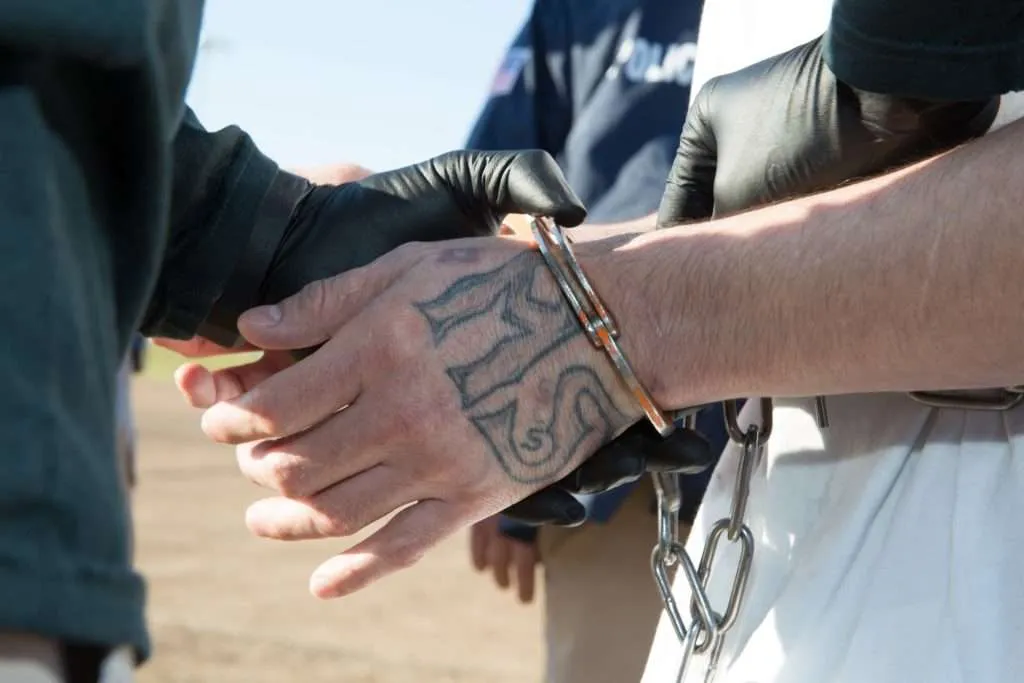
Photo: MS-13 gang member with assault convictions removed to El Salvador - U.S. Immigration and Customs Enforcement
El Salvador received 10,504 deportees in the first six months of 2026, according to the General Directorate of Migration and Foreign Nationals (DGME). That is 73.8% more than in the same period of 2025.[1] Most land on US Immigration and Customs Enforcement (ICE) charter flights at the international airport near Comalapa. Most then go home. However, a returnee who matches the police profile of a gang suspect can be taken from the airport straight to prison. Families often cannot find them there, and hundreds of detainees have died.
For El Salvador deportees, the danger in 2026 comes mainly from the state, not from the gangs. The state of exception (régimen de excepción) that began on 27 March 2022 still suspends key arrest safeguards.[2] This article follows a returnee from the aircraft to the reception centre, the police check and, for some, detention. It then sets out who is most at risk and what UK and US lawyers need to prove. For the wider country picture, read our El Salvador country conditions report.
Salvadorans deported, January to June 2026 (DGME)
ICE deportation flights to El Salvador, January to August 2026 (Human Rights First)
Share of 9,000+ Salvadorans deported in 2025 with a violent US conviction (HRW, March 2026)
Deaths in state custody under the state of exception, to 3 August 2026 (SJH)
El Salvador deportees in 2025-2026: flights and numbers
Deportees now arrive in El Salvador faster than at any time since 2019. The DGME counted 16,051 deportees in 2025, a 7.1% rise on 2024.[3] The rise then sped up. In the first half of 2026 the figure reached 10,504, compared with 6,044 a year earlier. Almost all came by air from the United States.[1] For context, the 2019 total was 37,348, so current numbers are high but not a record.
Flight data tell the same story. Human Rights First tracks ICE flights each month. It counted 116 deportation flights to El Salvador between January and August 2026, with a peak of 18 in July.[4] All of them landed at the San Óscar Arnulfo Romero y Galdámez International Airport, often still called Comalapa after the nearby town.
Who is on these flights matters for risk. Human Rights Watch (HRW) analysed ICE data on more than 9,000 Salvadorans deported since January 2025. Only 10.5% had a US conviction for a violent or possibly violent crime.[5] In other words, most deportees are people removed for immigration breaches, many after years in the US. That point cuts both ways. Most returnees are not targets. Even so, the government does not publish how many deportees police arrest on arrival, so no one can measure the risk from official data.[6]
Arrival at the airport: from the plane to the CAIM
Reception follows a set path. Salvadoran authorities first identify each passenger on the aircraft list. Returnees are then received by the DGME's Migrant Care Unit (Gerencia de Atención al Migrante, GAMI). According to the DGME's annual report, GAMI attended 18,469 returnees between June 2025 and May 2026, about 51 a day. Men made up 83.5% of them.[1]
From the airport, returnees may be taken to the Comprehensive Migrant Care Centre (Centro de Atención Integral para el Migrante, CAIM). The DGME runs it on the south-eastern edge of San Salvador. Families still call the older site "La Chacra".[6] There, officials record personal details and an address. One young man, deported in December 2023 after leaving El Salvador at the age of 12, had no address to give. Officials released him to an uncle, but police took him again two weeks later.[6]
The second and third check
Before March 2022, a returnee without a criminal record was documented and walked out of the main door, often carrying only a plastic bag. Since the state of exception, returnees go through a second or third evaluation, because the emergency rules allow police to jail them on arrival.[6] The check focuses on three things: police and gang databases, tattoos, and any US criminal history shared by ICE.
Tattoo checks are not new. As early as April 2022, the BBC reported that police asked returnees and residents about gang tattoos. In one case, a former MS-13 member was held "only for the tattoos" despite a clean record certificate.[7] HRW and Cristosal later found that many arrests rested on "appearance and social background".[8] For deportees to El Salvador, the airport is the first place where that profiling takes place.
The "red code" claim: In one 2023 case, a police officer told a deportee's mother that "all who come deported, come with a red code". She understood this as an Interpol notice. When pressed, he said the arrest was made under the emergency regime. Expediente Público found no basis for a general red notice on deportees.[6]
Arrests of El Salvador deportees under the state of exception
The legal basis for airport arrests is Legislative Decree 333 of 27 March 2022, issued under Article 29 of the Constitution. It suspends the right to be told the reason for arrest and the right to a lawyer. It also extends police custody before a judge from 72 hours to 15 days.[2] The Legislative Assembly approved its 55th monthly extension on 23 September 2026, running to 27 October 2026. By then the Salvadoran government counted 93,162 arrests under the measure.[2] We could not confirm the text of a later extension at the time of writing, but the government has given no sign of ending it.
Documented cases show a clear pattern. Police detained a returnee who arrived on 11 August 2023 at 3:30 pm the same day, "under the state of exception and in flagrante". Prosecutors charged him with unlawful association, and a judge ordered pre-trial detention on 25 August.[6] Another man was deported on 30 August 2023. Police held him for 15 days at the Zacatecoluca station, about 29 km from the airport, and then moved him to Izalco prison.[6] Zacatecoluca is often the first holding point before transfer to one of the country's prisons.
Enforced disappearance after removal
The HRW report of 16 March 2026 is the main source on 2025 removals. HRW interviewed 20 relatives and lawyers of 11 men deported between mid-March and mid-October 2025 and detained on arrival. None had been allowed contact with family or a lawyer, and none had been taken before a judge.[5] Salvadoran officials told relatives they "lacked a legal mandate" to give information. In five cases, families learned where the men were held only through proceedings before the Inter-American Commission on Human Rights (IACHR). El Salvador later told the IACHR that four were in Santa Ana prison and one was in CECOT, held "pending the decision of the sending State".[5]
HRW describes these cases as enforced disappearances under international law. The IACHR granted precautionary measures to three deportees in Resolution 82/2025 of 17 November 2025.[9] Meanwhile, habeas corpus offers little. The Constitutional Chamber rejected one deportee's petition because the facts were not "precise" and did not answer the others.[5] Our article on El Salvador arbitrary detention explains how families search for detainees and why habeas corpus rarely works.
CECOT and the 2025 US transfers to El Salvador
The Terrorism Confinement Centre (CECOT) in Tecoluca became part of US removal policy in 2025. On 3 February 2025, President Nayib Bukele met Secretary of State Marco Rubio. He then offered to take US deportees of any nationality and hold convicted criminals in his prisons for a fee.[10] On 15 and 16 March 2025, the US sent 238 Venezuelans to CECOT under the Alien Enemies Act of 1798, and 252 in total by April. The White House said it paid about US$6 million.[10] The same flights carried 23 Salvadorans, including the alleged MS-13 leader César Humberto López Larios.[5]
The Venezuelans spent about four months held incommunicado before a prisoner exchange returned them to Venezuela on 18 July 2025.[11] HRW and Cristosal interviewed 40 of them for the report "You Have Arrived in Hell" (12 November 2025). The men described kicks, punches and baton blows almost every day during cell searches. Three described sexual violence by guards.[12] Many had no criminal conviction anywhere.
These accounts are first-hand evidence of how Salvadoran guards treat people sent from the US. They also show how tattoos were used. US officials relied partly on tattoos to label the Venezuelans as gang members, the same marker Salvadoran police use at the airport.[12] For Salvadoran nationals, the risk is greater still. A Salvadoran labelled a gang member faces trial at home, not just custody, and the Penal Code now allows life imprisonment for gang membership.[11]
US court cases on removals to El Salvador: J.G.G. and Abrego Garcia
Two lines of US litigation shape any argument about removals to El Salvador. The first is J.G.G. v Trump, the Alien Enemies Act case. On 7 April 2025, the Supreme Court held that people designated under the Act must receive notice. They must also have a chance to seek habeas corpus where they are held.[13] On 16 May 2025, in A.A.R.P. v Trump, it found that about 24 hours' notice without information on how to challenge removal was not enough.[13]
Back in the district court, Chief Judge James Boasberg ruled in December 2025 on a class of about 137 Venezuelan men sent to CECOT. He found that the government had violated their due process rights. On 12 February 2026 he ordered the government to give them a route to hearings, including from abroad.[13] By March 2026 the ACLU said 90 class members still sought relief. We found no appellate ruling on the remedy as of October 2026.
Kilmar Abrego Garcia
The second case shows what happens when a Salvadoran with protection is removed anyway. An immigration judge granted Kilmar Abrego Garcia withholding of removal in 2019, based on Barrio 18 threats. Despite that order, the US deported him to El Salvador on 15 March 2025 and later called it an "administrative error".[5] On 10 April 2025, the Supreme Court required the government to "facilitate" his return.[14] He came back on 6 June 2025 to face criminal charges in Tennessee. His lawyers said he suffered physical abuse in Salvadoran prisons.[5]
A Maryland federal court ordered his release from ICE custody on 11 December 2025. In February 2026, it barred his re-detention, and his removal case was still before the courts in October 2026.[14] For practitioners, the case proves a simple point. A withholding order to El Salvador did not stop a removal, and the person removed went straight into Salvadoran custody.
In our video on how we assess return risk, we explain how an expert weighs a returnee's profile, record and home area against the country evidence.
Detention after arrest: incommunicado custody and deaths
A deportee who is arrested enters the same system as every other detainee. Police may hold them for 15 days. A judge then usually orders pre-trial detention. Since an August 2025 reform of the organised crime law, it can last up to five years for alleged members of criminal groups.[11] Mass trials can join hundreds of defendants in one hearing.
Deaths in custody are the gravest risk. Socorro Jurídico Humanitario (SJH) counted at least 554 deaths by 3 August 2026, and it says 94% of the dead had no gang profile.[15] Cristosal, which checks each case against records, reported 513 deaths to a US congressional commission in April 2026. Of the 420 it examined in detail, 181 bodies showed signs of violence.[15] Amnesty International documented at least 470 deaths in its July 2026 report and said the pattern may amount to crimes against humanity.[16]
Deportees who died
Cristosal has documented five Salvadorans deported from the US who were arrested at the airport and later died in prison.[17] One was José Emilio Canizales Villalta, a 26-year-old farm worker from Jiquilisco, Usulután. He had entered the US through the CBP One app in January 2023 and was deported in August 2023. His family looked for him at the migrant centre, but police had already taken him to Quezaltepeque prison. A prison certificate dated 15 August 2023 showed no conviction or pending case. He died on 30 November 2023, and the forensic report gave acute pulmonary oedema as the preliminary cause.[17] According to Cristosal, about 40% of death records it reviewed give the same general cause.
Which El Salvador deportees face the highest risk
Not every returnee faces the same danger. For returnees, risk rises with each marker that matches the police profile. The table sets out the main groups and the evidence for each.
| Profile | Why the risk rises | Key evidence |
|---|---|---|
| Tattooed returnees | Visible gang-style or any large tattoos trigger airport and street checks | BBC (2022); HRW and Cristosal (2022, 2025) |
| Former gang members | Old police files; life sentence for gang membership since April 2026 | EFE (April 2026); EMAP PSG finding |
| People with US criminal records | ICE shares records; officials treat records as gang indicators | HRW (March 2026); Expediente Público (April 2026) |
| Relatives of gang members or detainees | Broad idea of "collaboration"; family already known to police | NPR (2024); Bukele statement (October 2026) |
| Young men from former gang areas | Home address and age fit arrest quotas | HRW statement to US Congress (April 2026) |
| LGBT returnees | Abuse by state agents; no gender recognition | ASPIDH: 301 complaints, January to September 2025 |
| Critics and journalists | Foreign Agents Law; prosecution of NGO staff | HRW World Report 2026; APES |
Tattoos, past gang links and US records
Tattoos are the most visible marker, and a returnee cannot easily hide them. In El Salvador, a past gang link is now far more serious than before 2022. Since 26 April 2026, reforms to the Criminal Code impose life imprisonment for gang membership.[11] As a result, a man who left a gang 15 years ago in Los Angeles can face the same charge as an active member. A US record adds a further risk. HRW found that relatives of ten detained deportees said the men had served US sentences, mostly for drug possession.[5] Police appear to treat any record as a sign of gang links.
Relatives and people who fled gang threats
People who fled gang threats before 2022 face a mixed picture. The Home Office says gang risk is now low in most areas.[18] However, a person who once paid extortion or was forced to help a gang may be treated as a collaborator. Families of detainees are also exposed, because their names appear in police searches and habeas petitions. In addition, HRW found that some deportees in its sample had fled extortion and recruitment threats.[5] Their old contact with the gang became a new risk from the state.
LGBT deportees and critics
El Salvador has no law against discrimination on grounds of sexual orientation or gender identity. The ASPIDH LGBTIQ+ Observatory recorded 301 complaints between 1 January and 22 September 2025 and named state agents among the main perpetrators.[19] In our assessment, a trans woman whose appearance differs from her identity document faces a specific risk of abuse at any police check.
Critics face a separate threat. The Foreign Agents Law (Decree 308) of 20 May 2025 imposes a 30% tax on foreign funding under Article 11.[20] Cristosal moved its staff out of the country in July 2025, and the journalists' association APES counted 53 journalists forced into exile in 2025.[20] A deportee who criticised Bukele online from the US, or who worked with a Salvadoran NGO, should expect that profile to be known to the authorities.
Release without reintegration in El Salvador
Returnees who pass the airport checks still face weak support. GAMI's main programme in 2025-2026 was identity documents. It had issued 3,103 identity cards (DUI) to returnees by March 2026, and its budget for the programme was about US$22,157 for June to December 2025.[1] El Salvador has a National Reintegration Plan for 2025-2029. Civil society groups told the Tico Times, however, that it lacks the funding and staff to handle current volumes.[21]
The Home Office's own country note quotes Freedom House on this point. Under the state of exception, "authorities have cracked down on programs that support the rehabilitation and reintegration of formerly incarcerated individuals".[18] This matters for a deportee with a US record. The groups that once helped former prisoners and former gang members find work have shrunk, and many NGO workers have left. Our wider analysis of risks facing long-term deportees in the Northern Triangle covers stigma, family loss and economic exclusion across the region.
Lack of support also feeds arrest risk. A returnee with no address, no job and no local ties is more visible in a poor neighbourhood. In addition, a young man who reappears after years abroad is easy for local police to notice.
UK claims by El Salvador deportees: the CPIN gap
The Home Office's only current note on El Salvador is the Country Policy and Information Note: Fear of gangs, El Salvador (version 5.0, December 2025). It says there are "very strong grounds supported by cogent evidence" to depart from the country guidance case EMAP (Gang violence, Convention Reason) El Salvador CG [2022] UKUT 335 (IAC).[18] In its view, gangs are no longer political actors. As a result, the social groups recognised in EMAP, including former gang members, no longer apply to a fear of gangs.
The note has a clear gap for people returned to El Salvador. It deals with fear of gangs. It has no section on the treatment of returnees at the airport, and it does not assess arrests of deportees under the state of exception. Its only reference to returnees is a list of NGOs, including FESPAD, which supports them.[18] The Home Office removed its separate note on actors of protection in August 2024.
For a client who fears the state, the legal route is different. Fear of arrest as a suspected gang member can engage imputed political opinion, because the government frames the gangs as terrorists. Where no Convention reason applies, Article 3 ECHR and humanitarian protection remain open. In addition, EMAP remains binding country guidance until the Upper Tribunal replaces it, under SG (Iraq) v SSHD [2012] EWCA Civ 940.[22] An expert report can test whether the CPIN's evidence meets that standard for a returnee with the client's profile.
Practice point: In a UK case, frame the risk as the moment of return. Ask whether the client's tattoos, record, home area or family links make detention by police reasonably likely. Then ask what treatment follows. The CPIN does not answer that question.
US claims: withholding, CAT and TPS for Salvadorans facing removal
In the US, gang-based asylum claims have narrowed sharply since 2025. Matter of D-G-E-A- & N-G-G-E-, 29 I&N Dec. 570 (BIA 2026), holds that opposition to gangs alone is not a political opinion.[23] As a result, many El Salvador deportee cases now turn on withholding of removal under INA section 241(b)(3) and protection under the Convention against Torture (CAT).
CAT and prison conditions
Under 8 CFR 1208.18(a), torture requires specific intent and the involvement or acquiescence of a public official. Matter of J-E-, 23 I&N Dec. 291 (BIA 2002), held that poor prison conditions alone are not torture without specific intent. However, the CECOT evidence goes further than poor conditions. It records near-daily beatings by guards, sexual violence, denial of food and medicine, and deaths with signs of violence.[12] Because Salvadoran guards are state agents, acquiescence is not in issue. Matter of H-L-S-M-, 29 I&N Dec. 767 (BIA 2026), says a CAT claim cannot rest on general evidence of corruption, which makes case-specific evidence more important.[23]
Two further rules matter for deportees. First, under Matter of J-F-F-, 23 I&N Dec. 912 (A.G. 2006), each step in a chain of events must be more likely than not. For an El Salvador deportee, the chain is identification at the airport, detention, and torture in custody, so evidence is needed for each link. Second, a client with a serious conviction may be barred from withholding but can still receive deferral of removal under 8 CFR 1208.17. In Matter of G-A-, 23 I&N Dec. 366 (BIA 2002), the Board granted deferral to an Iranian man whose US drug conviction made torture on return likely.[23] That reasoning fits a Salvadoran returnee whom police will flag through ICE records.
TPS for El Salvador
About 170,000 Salvadorans hold Temporary Protected Status. DHS extended the designation in January 2025 to 9 September 2026.[24] That date passed with no published decision. DHS said holders keep their protection and work permits until it announces one, while AILA warned that relying on automatic extension carries risk.[24] Some media reported the programme as ended. As of mid-September 2026 we found no Federal Register notice either way, so check before every hearing. TPS holders who now seek asylum must also deal with the one-year filing deadline.
Evidence for El Salvador deportee claims and the expert's role
Strong claims rest on the client's own profile, matched to dated evidence. Useful documents include:
- clear photographs of every tattoo, with dates and meaning, and any removal records;
- US criminal records and the ICE removal file, because Salvadoran police may receive the same data;
- any Salvadoran police record certificate, past arrests or releases under the state of exception;
- arrests, habeas petitions or IACHR filings concerning relatives;
- evidence of the home area, including whether police and army run checkpoints there;
- social media posts, NGO work or press contact that could mark the client as a critic.
What open sources miss
Open sources leave large gaps on El Salvador deportees. The government publishes no figures on airport arrests. The DGME reports arrivals, not detentions. HRW's sample covers 11 men, and Cristosal's five deaths are those it could verify. Moreover, Cristosal now works from outside the country, and many lawyers refuse deportee cases for fear of reprisals.[5] Decision-makers often read these small numbers as proof of low risk, rather than as a sign that the data are hidden.
A country expert can fill that gap in three ways. First, the expert can explain how screening works at the airport and in the home district, based on Spanish-language sources and contact with Salvadoran lawyers and NGOs. Second, the expert can place the client's markers against known arrest patterns, such as quotas, tattoo checks and "collaboration" charges. Third, the expert can describe what follows arrest. That means 15 days of police custody, years of pre-trial detention and the death record in prisons such as Izalco, Santa Ana and Quezaltepeque. Timescales are agreed when the instruction is accepted. To instruct a specialist, see our El Salvador expert witness reports page or find an expert witness.
Conclusion: the airport as the point of risk
Deportations to El Salvador rose by almost three quarters in the first half of 2026, and flights arrive several times a week. Most returnees pass through GAMI and the CAIM and go home. However, those who match the police profile can be detained on arrival under emergency powers in force since March 2022. Their families may not learn where they are for months. The CECOT accounts, the HRW cases and the deaths of deportees in custody show what that detention can mean.
For UK and US lawyers, the question is no longer whether gangs will find the client. It is whether the state will. The answer depends on tattoos, records, family, home area and public profile. Each of those facts needs dated evidence, because the official data say nothing about who is arrested at the airport.
Footnotes
- Diario El Mundo, 'Atención al Migrante reportó 18,469 salvadoreños retornados con un alza del 41% en un año' (21 August 2026), citing the Dirección General de Migración y Extranjería annual report (memoria de labores) for June 2025 to May 2026 link
- EFE, 'El Salvador prorroga régimen de excepción: suma más de 93 mil arrestos', La Silla Rota (24 September 2026) link; Asamblea Legislativa, Decreto Legislativo No. 333 (27 March 2022); Constitution of El Salvador 1983, arts 13, 29 and 30
- Diario El Mundo, 'El Salvador recibió 16,051 deportados en todo 2025, según Migración' (5 February 2026) link
- El Diario de Hoy, 'EE. UU. mantiene ritmo constante de deportaciones: El Salvador suma 116 vuelos de retorno a agosto de 2026' (21 September 2026), citing Human Rights First monthly ICE flight monitoring link
- Human Rights Watch, 'US/El Salvador: Deportees Forcibly Disappeared' (16 March 2026) link
- Expediente Público, 'Deportados en EE. UU., desaparecidos en El Salvador' (21 April 2026), including case accounts and the GIPES figures of 24 March 2026 link
- BBC News Mundo, 'Bukele contra las maras: "No debo nada, me quieren capturar por tener las letras MS tatuadas"', republished by Prensa Libre (21 April 2022)
- Human Rights Watch and Cristosal, ''We Can Arrest Anyone We Want': Widespread Human Rights Violations under El Salvador's State of Emergency' (7 December 2022)
- IACHR, Resolution 82/2025, MC 1150-25, 1152-25 and 1153-25 (17 November 2025), as reported by El Diario de Hoy, 'CIDH otorga medidas de protección para tres salvadoreños deportados y encarcelados' (November 2025)
- Euronews, 'El Salvador offers to accept deportees and US nationals in outsourcing of US prison system' (4 February 2025); Poder360, 'EUA dizem ter pago US$ 6 mi para enviar venezuelanos a El Salvador' (17 March 2025), quoting White House press secretary Karoline Leavitt
- Human Rights Watch, 'World Report 2026: El Salvador, Events of 2025' (2026) link; EFE, 'En vigor la polémica reforma que habilita la cadena perpetua para menores en El Salvador', Infobae (26 April 2026)
- Human Rights Watch and Cristosal, ''You Have Arrived in Hell': Torture and Other Abuses Against Venezuelans in El Salvador's Mega Prison' (12 November 2025)
- Trump v J.G.G., No. 24A931 (US Supreme Court, 7 April 2025); A.A.R.P. v Trump, No. 24A1007 (US Supreme Court, 16 May 2025); J.G.G. v Trump, No. 1:25-cv-00766 (D.D.C.), as reported by NPR, 'Judge orders Trump administration to return deported Venezuelans to the U.S.' (22 December 2025) and Connecticut Public, 'Federal judge orders return of Venezuelan migrants deported to El Salvador under Alien Enemies Act' (12 February 2026); Law360 (10 March 2026) on the ACLU's statement that 90 class members seek relief
- Noem v Abrego Garcia, No. 24A949 (US Supreme Court, 10 April 2025); Democracy Now, 'Federal judge blocks efforts by Trump administration to rearrest Kilmar Abrego Garcia' (18 February 2026); ABC News, 'Kilmar Abrego Garcia returns to federal court to continue fighting deportation case' (6 October 2026)
- EFE, 'La cifra de muertes en cárceles de El Salvador aumenta a 554 bajo el régimen de excepción', La Prensa (3 August 2026), citing Socorro Jurídico Humanitario link; Diario El Mundo, 'Cristosal denuncia abusos bajo régimen de excepción ante comisión del Congreso EEUU' (16 April 2026)
- Amnistía Internacional, '"Seguridad" sin derechos: El impacto de las detenciones arbitrarias masivas y la negación del debido proceso en la posible comisión de crímenes de lesa humanidad en El Salvador' (15 July 2026)
- RFI, 'El Salvador, deportados y muertos bajo custodia del Estado', republished by Radio Universidad de Chile (26 September 2026), including an interview with René Valiente (Cristosal) link
- Home Office, 'Country Policy and Information Note: Fear of gangs, El Salvador' (Version 5.0, December 2025), assessment updated 14 October 2025, executive summary, paras 2.1.1-2.1.9, 13.1.5 and 13.1.7; GOV.UK collection page change history (28 August 2024) link
- Washington Blade, 'El Salvador: el costo del silencio oficial ante la violencia contra la comunidad LGBTQ' (10 November 2025), citing the ASPIDH LGBTIQ+ Observatory
- Asamblea Legislativa, Decreto No. 308, Ley de Agentes Extranjeros (20 May 2025), art 11; Human Rights Watch (n 11); EFE, 'Asociación de Periodistas de El Salvador registró 426 agresiones contra la prensa en 2025', SWI swissinfo.ch (May 2026)
- Tico Times, 'U.S. deportations of Salvadorans nearly double in first quarter of 2026' (14 May 2026)
- EMAP (Gang violence, Convention Reason) El Salvador CG [2022] UKUT 335 (IAC); SG (Iraq) v Secretary of State for the Home Department [2012] EWCA Civ 940
- Immigration and Nationality Act s 241(b)(3), 8 USC 1231(b)(3); 8 CFR 1208.16-1208.18; Matter of J-E-, 23 I&N Dec. 291 (BIA 2002); Matter of G-A-, 23 I&N Dec. 366 (BIA 2002); Matter of J-F-F-, 23 I&N Dec. 912 (A.G. 2006); Matter of D-G-E-A- & N-G-G-E-, 29 I&N Dec. 570 (BIA 2026); Matter of H-L-S-M-, 29 I&N Dec. 767 (BIA 2026)
- Department of Homeland Security, 'Extension of the Designation of El Salvador for Temporary Protected Status', Federal Register (17 January 2025) link; AILA, 'Practice Alert: DHS Fails to Make an Official Determination on TPS for El Salvador' (9 September 2026); Spectrum News, 'DHS: Salvadoran TPS holders retain protection despite expiration' (9 September 2026)
Sources
- Human Rights Watch, US/El Salvador: Deportees Forcibly Disappeared, March 2026
- Home Office, Country Policy and Information Note: Fear of gangs, El Salvador, December 2025
- Federal Register, Extension of the Designation of El Salvador for Temporary Protected Status, January 2025
- Human Rights Watch, World Report 2026: El Salvador, 2026
- Expediente Público, Deportados en EE. UU., desaparecidos en El Salvador, April 2026
- Diario El Mundo, Atención al Migrante reportó 18,469 salvadoreños retornados, August 2026
- Diario El Mundo, El Salvador recibió 16,051 deportados en todo 2025, February 2026
- El Diario de Hoy, El Salvador suma 116 vuelos de retorno a agosto de 2026, September 2026
- Radio Universidad de Chile (RFI), El Salvador, deportados y muertos bajo custodia del Estado, September 2026
- La Silla Rota (EFE), El Salvador prorroga régimen de excepción: suma más de 93 mil arrestos, September 2026
- La Prensa (EFE), La cifra de muertes en cárceles de El Salvador aumenta a 554, August 2026
- Human Rights Watch and Cristosal, We Can Arrest Anyone We Want, December 2022
- Tico Times, U.S. deportations of Salvadorans nearly double in first quarter of 2026, May 2026
- AILA, Practice Alert: DHS Fails to Make an Official Determination on TPS for El Salvador, September 2026
- US Department of Justice, EOIR, Volume 29 precedent decisions, 2025-2026
Need an expert witness report for your case?
Our country experts provide independent reports for asylum and immigration cases in the UK, US, Canada, and EU.
Order an expert witness report |
Find a country expert witness |
About our expert team