Last updated:
Members of the Pakistan Ahmadiyya community cannot vote on the general roll or get a passport without signing a statement about their faith. In many districts, they also cannot bury their dead in a shared graveyard or sacrifice an animal at Eid without police action. This page sets out that everyday exclusion, with dated incidents from 2023 to 2026. It then explains how these daily limits feed the "openly practise" test in UK and US asylum claims.
The page does not repeat the legal history of the 1974 amendment and Ordinance XX. For that, see Ahmadiyya Muslims in Pakistan: declared non-Muslim by law. For the general structure of a claim, see our Pakistan Ahmadiyya persecution and asylum guide.
Ahmadi graves desecrated or destroyed in 2025, 77 of them by police (IHRD)
Criminal cases (FIRs) filed against Ahmadis in 2025 (IHRD)
Of 42 attacks on Ahmadi worship places in 2023/24 done or supervised by law enforcement (HRCP)
Ahmadis in the 2023 census, against a community estimate of 400,000-600,000 (CPIN, March 2025)
Pakistan Ahmadiyya exclusion at a glance
Ahmadi exclusion in Pakistan works through forms, permits and police choices as much as through trials. The Home Office accepts this. Its Country Policy and Information Note (CPIN) on Ahmadis (version 6.0, March 2025) says Ahmadis must swear they are non-Muslim to get an identity card.[1] It also says they can vote only on a separate list. As of November 2026, this is still the current Home Office note. However, its country information stops at 30 November 2024.
Pakistan's own National Commission for Human Rights (NCHR) reached a similar view. Its Situation Report II came out in March 2026 and covers 12 September 2023 to 15 December 2025.[2] It records sealed places of worship, damaged graves, criminal cases for routine prayer and separate voter rolls. Because a state body wrote it, the Home Office cannot dismiss it as community advocacy.
| Area of life | What Ahmadis face | Legal or administrative basis |
|---|---|---|
| Voting | Separate supplementary voter list; Muslim registration requires denouncing the founder | Elections Act 2017 s 48A (from Conduct of General Elections Order 2002, arts 7B and 7C) |
| CNIC and passport | Oath declaring Ahmadis non-Muslim, or a declaration that the applicant is "not a Muslim" | NADRA and passport application forms |
| Burial | Blocked burials in shared graveyards; Islamic inscriptions erased from gravestones | PPC s 298-B/C as applied by police; often no written order |
| Places of worship | Minarets and prayer niches removed; buildings sealed | PPC s 298-B/C; district "public order" decisions |
| Eid al-Adha | FIRs, preventive detention, surety bonds, confiscated animals | PPC s 298-C; Punjab Maintenance of Public Order Ordinance 1960 |
| Education and work | Faith declarations on admission and bar enrolment; teachers transferred | Admission forms; bar council notices |
| Publications | Ahmadi newspaper, periodicals and the founder's works banned in Punjab | Punjab government orders; Punjab Holy Quran (Printing and Recording) Act |
Voting: the separate electoral list and the 2017 oath crisis
Ahmadis in Pakistan are the only religious group kept off the joint electorate. On 27 February 2002, Chief Executive's Order No. 7 restored joint voting for all citizens. Four months later, however, Order No. 15 added Articles 7B and 7C to the Conduct of General Elections Order 2002.[3] Article 7B kept the "status of Ahmadis" unchanged. Article 7C let anyone challenge a voter's claim to be Muslim. The voter then had to sign a declaration on the finality of prophethood or move to the supplementary list.
The Elections Act 2017 first left these provisions out. It also changed the candidate oath from "I solemnly swear" to "I believe". Religious parties protested at once. In October and November 2017, Parliament restored the oath and inserted section 48A.[4] Section 48A keeps the status of Ahmadis "unchanged" and carries Articles 7B and 7C into the Act. Even so, Tehreek-e-Labbaik Pakistan (TLP) blocked the Faizabad interchange in Islamabad for three weeks. Law Minister Zahid Hamid resigned in late November 2017 as part of the deal that ended the sit-in.
The courts then went further. On 9 March 2018, Justice Shaukat Aziz Siddiqui of the Islamabad High Court said that applicants for the civil service, judiciary and armed forces should declare their faith.[5] He also told NADRA to set time limits for changing the religion on a citizen's record. In short, the oath politics of 2017 gained a judicial form.
What registration means in practice
Every new voter in Pakistan fills in Form A. "Muslim" and "Qadiani/Ahmadi" appear as separate boxes. An Ahmadi who ticks "Muslim" must swear that the community's founder was an impostor. Amjad Mahmood Khan of the Ahmadiyya Muslim Community USA gave evidence on this to the Tom Lantos Human Rights Commission on 24 July 2025.[6] He said section 48A "mandates that Ahmadi Muslims continue to be segregated via a separate voter list".
As a result, most Ahmadis in Pakistan do not vote. The US State Department reported that "rather than deny their beliefs, most Ahmadis did not vote at all".[7] Human Rights Watch made the same point on 8 December 2023, before the general election.[8] At that election on 8 February 2024, the NCHR found the separate list still in use. It warned that public display of the list "exposed community members to possible harassment and identification".[2] The list carries names and addresses. Therefore, registering to vote can itself make a family visible to local activists.
The same oath also blocks public office. Elected Muslim officials must swear to the finality of prophethood. In addition, Ahmadis cannot take seats reserved for non-Muslims unless they accept the non-Muslim label. Even in Rabwah, where Ahmadis are the majority, local councils have no Ahmadi member, according to the community.[1]
Passports, CNIC and the faith declaration in Pakistan
The identity card (CNIC) is the key document in Pakistan. According to the CPIN, people need it for a passport, a driving licence, a tax number and voter registration.[1] They also need it for formal jobs, bank accounts, SIM cards, utilities, land and further education. NADRA, the national registration authority, asks every applicant to state a religion. The card itself does not show it.
Ahmadis face two versions of the same trap. If they write "Muslim", they must sign that Mirza Ghulam Ahmad was an impostor. If they write "Ahmadi", they must sign: "I declare on oath that I am not a Muslim and I belong to Qadiani/Ahmadi religion."[1] There is no third option. A British High Commission official confirmed on 24 April 2021 that NADRA treats a form without the finality declaration as incomplete and does not process it.
Passports add one more layer. Pakistan added the religion column again in 2005, and the passport records the holder's faith.[1] Community leaders told Home Office researchers in August 2024 that a passport issued without the declaration says "Ahmadi". Moreover, since 13 December 2018, NADRA has not let a person recorded as Muslim change to another faith. That rule matters for converts to Ahmadiyya and for Ahmadis who once signed as Muslim.
Marriage records now follow the same path. In October 2022, the Punjab government added the finality oath to the nikah nama form.[1] Then, from 2024, NADRA stopped accepting marriage and divorce certificates issued by the community, the NCHR reports. It sends couples to union councils, which often refuse to register them.[2] The NCHR describes a "growing backlog" of couples without the records they need for family registration and inheritance.
Practice note: A Pakistani passport that says "Muslim" does not by itself undermine an Ahmadi claim. Some families signed under pressure, and some older papers were filed by a relative. The real question is why the document says what it says. A country expert can explain the form history and the 2018 NADRA rule.
Ahmadi graves and burial: denied cemeteries and erased inscriptions
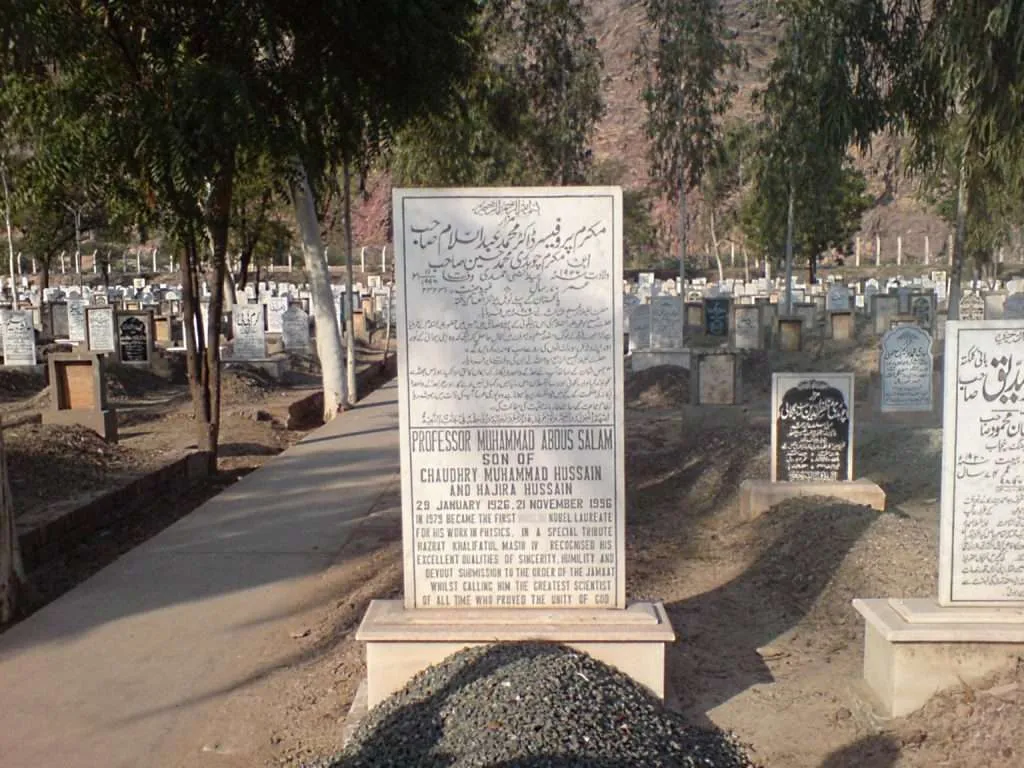
Burial is now one of the most frequent points of conflict for Ahmadis in Pakistan. The usual demand is that families remove the kalima, Quranic verses or the word "Muslim" from gravestones. If families refuse, police or council staff in Pakistan often do it themselves.[2] In many cases they act at night and without a written order.
The numbers rose sharply after 2023. The Ahmadiyya Foreign Mission recorded 67 desecrated graves in 2020, 128 in 2021, 144 in 2022 and 109 in 2023.[1] Next, the community's International Human Rights Desk (IHRD) counted 308 in 2024. It said the authorities caused 197 of them.[9] For 2025, the IHRD counted 381 graves, 77 of them by police. It also logged six funerals or burials that were restricted or stopped.[10] These are community figures. Still, the NCHR, the HRCP and the CPIN all confirm the same pattern.
Dated incidents
- September 2023, Daska (Sialkot): police vandalised at least 74 graves, according to the CPIN.[1]
- 25 January 2024, Daska: police led the destruction of at least 80 tombstones after a campaign by religious activists.[2]
- 27-28 September 2024, Vehari: police defaced Ahmadi gravestones and showed no written order.[2]
- 21 March 2025, Kotli (Azad Jammu and Kashmir): attackers desecrated 76 Ahmadi graves.[6]
- 23-24 February 2026, Gajju Chak (Gujranwala): police stopped the burial of an 80-year-old Ahmadi woman in the shared village graveyard. They let it go ahead only after community leaders signed a police-drafted promise never to use that graveyard again.[11]
In Khushab, the NCHR found that police told Ahmadis to remove their own grave markers before officers did it. In the Commission's words, the affected community bore "responsibility for compliance".[2] The NCHR also noted that the police action in Daska and Musaywala breached section 297 of the Pakistan Penal Code. That section makes trespass on burial places an offence.
The issue of Pakistan Ahmadiyya burials has now reached the UN. In January 2026, the UN Special Rapporteur on freedom of religion or belief, Nazila Ghanea, published a report on religion and the dead (A/HRC/61/50).[12] She argues that severe burial limits can force the living to hide their beliefs. According to the community's summary, the report names Pakistan and its treatment of Ahmadi graves and funerals.
Ahmadi mosques: minarets, prayer niches and sealed buildings
On paper, the law on Ahmadi places of worship in Pakistan is clearer than the practice. In September 2023, the Lahore High Court ruled on a minaret built in 1922 at an Ahmadi site in Wazirabad.[1] It held that sections 298-B and 298-C do not require anyone to alter buildings from before 1984. Nevertheless, police demolitions continued.
The Human Rights Commission of Pakistan (HRCP) recorded at least 42 attacks on Ahmadi places of worship in its 2023/24 review.[13] Law enforcement agencies carried out or supervised nearly 60 per cent of them. For example, the NCHR lists police demolishing minarets at Samundri on 22 December 2023.[2] Gujranwala police removed minarets from two sites on 10-11 October 2024. Similarly, police in Depalpur (Okara) took down minarets in September 2024, during events for the 50th anniversary of the 1974 amendment.
In 2025, sealing became as common as demolition. For instance, the authorities closed the Bait-ul-Nasir centre in Karachi from February to March 2025 after weeks of agitation. Across the year, the IHRD counted 13 sealed places of worship, 13 minarets and 10 prayer niches destroyed, and one building razed.[10] USCIRF's 2026 Annual Report, released on 4 March 2026, also covered this period.[14] It noted TLP members tearing down minarets in Sialkot in February 2025. The next month, police arrested dozens of Ahmadis, including children, for Friday prayers.
Mob attacks on Ahmadis in Pakistan also grew larger. Between July and October 2025, police filed six FIRs over four big attacks in Motra (Sialkot) and Dijkot (Faisalabad).[2] The FIRs named about 137 people and cited about 950 unknown attackers. Then, on 10 October 2025, a gunman opened fire at Bait-ul-Mahdi in Rabwah and wounded eight Ahmadi volunteers.[10] On 23 October 2025, the federal government approved a ban on TLP under the Anti-Terrorism Act 1997. Afterwards, the NCHR found few organised attacks in November and December 2025. Even so, it added that many Ahmadi places of worship in Karachi stay sealed.
Eid al-Adha arrests in Pakistan, 2023 to 2026
Eid al-Adha is the clearest yearly test of how far police in Pakistan will go into Ahmadi homes. Officers treat animal sacrifice (Qurbani) by an Ahmadi as "posing as a Muslim" under section 298-C. Each year, bar associations and Khatm-e-Nabuwwat groups ask police to stop it in advance.
- 2023: On 22 June 2023, the Lahore High Court Bar Association asked the Punjab authorities to stop Ahmadi Eid prayers and sacrifices. The think tank CRSS then counted at least five cases for sacrifices inside homes.[1] According to the HRCP, police filed these FIRs under section 298-C.
- 2024: Amnesty International documented 11 FIRs on 17-18 June 2024 across Punjab.[15] It also found preventive detention in Chakwal and Sialkot, and written bans on any Ahmadi sacrifice in Quaidabad, Mirpur and Kotli. A community spokesperson put arrests at 36 or more. In addition, the NCHR recorded detention under public order law, raids on homes and seized animals.[2]
- 2025: The NCHR described a "nationwide pattern" across Pakistan at both Eids. It listed bans on prayers, police searches of homes, seized animals, FIRs and detentions.[2] The IHRD also recorded criminal cases over the sacrifice in Sargodha, Faisalabad, Gujranwala and Gujrat.[10]
- 2026: At Eid in late May 2026, Ahmad Nagar police in Gujranwala filed FIR No. 529 under section 298-C.[16] The accused man was making a sacrifice for a dead relative's family. Police arrested him and three butchers, and a court sent him to Gujranwala jail on remand. Meanwhile, the Nankana Sahib peace committee announced that Ahmadis would get no permission for Qurbani. In Rawalpindi, a livestock traders' group told members on 20 May 2026 not to sell animals to Ahmadis. Police also took surety bonds from Ahmadis in Jaranwala, Chakwal, Jhelum and Dijkot.
The 2026 record matters for current claims. It shows that the TLP ban cut mob attacks but did not end police action under section 298-C against private acts of faith. Police in Punjab still used detention to prevent Eid rites. Anti-Ahmadi groups also kept urging the public to report sacrifices to police helpline 15.
Schools, jobs and the bar: exclusion at work and in education
Admission forms for public and private colleges in Pakistan ask for religion. Students who declare themselves Muslim must sign that Muhammad is the final prophet. According to the US State Department, refusing that statement "automatically disqualified" Ahmadi applicants.[7] The government's reply was that Ahmadis could enter if they did not claim to be Muslim. Ahmadis also may not teach Islamic studies in public schools, and Ahmadi students may not take Islam as a subject.[1]
Dated cases show the pressure on families. In February 2024, the authorities moved six Ahmadi teachers in Kotli district after a hate campaign.[1] In May 2024, a state school in Rabwah suspended an Ahmadi teacher. Later, in September 2024, a college in Sialkot dismissed a professor after student protests. The NCHR also recorded children expelled or refused entry in Rawalpindi and Sialkot.[2] In Taxila, a school expelled three siblings in the middle of term. Meanwhile, Punjab still has not returned eight Ahmadi schools and two colleges that the state took over in 1972.[1]
Job barriers for Ahmadis in Pakistan reach the legal profession itself. In 2023, the Gujranwala District Bar Council required new lawyers to condemn the founder of the Ahmadiyya community.[1] The Khyber Pakhtunkhwa Bar Council issued a similar notice in May 2023. Ahmadis also miss out on the 5 per cent job quota for minorities in state posts, unless they accept the non-Muslim label. The ILO Committee of Experts raised this discrimination again in February 2023. In business, the NCHR recorded organised boycotts in Narowal, Mandi Bahauddin and Lahore.[2] In Chiniot and Faisalabad, activists pushed traders to remove common religious phrases from shop signs.
Rabwah (Chenab Nagar) and the publication bans
Rabwah, officially renamed Chenab Nagar, is the only town in Pakistan where Ahmadis are the majority. The CPIN puts its Ahmadi population at about 60,000.[1] Many Ahmadis from other parts of the country are buried there. Yet community witnesses told Home Office researchers that Ahmadis "are not able to celebrate Eid in Rabwah". Instead, they change prayer times to avoid attention.
Public life in the town has tight limits. The community has not held its annual gathering in Pakistan since December 1983.[10] The authorities also ban outdoor rallies, conferences and community sports events in Rabwah. By contrast, Khatm-e-Nabuwwat groups hold large conferences on the town's edge every autumn. The IHRD estimates that about 17,000 people attended hostile events in Rabwah in September and October 2025. For this reason, Rabwah is not a quiet place to relocate. It is the most visible Ahmadi location in Pakistan.
Ahmadi literature is also largely illegal to print in Punjab. In 2015-2016, the Punjab government banned the Ahmadi daily Al-Fazl and the community's magazines for children, youth, women and elders.[1] It also banned the printing of the founder's complete works. Similarly, the Pakistan Telecommunication Authority has blocked community websites hosted abroad. The media regulator PEMRA has barred cable firms from carrying the MTA satellite channel. Sharing this material often leads to FIRs and to complaints under the Prevention of Electronic Crimes Act 2016.
The Mubarak Ahmad Sani judgment and its revision
The Mubarak Ahmad Sani case shows how fast courts in Pakistan can withdraw relief for Ahmadis. Police charged Sani over the distribution of an Ahmadi Quran commentary, Tafseer-e-Sagheer, in 2019. The charge relied on the Punjab Holy Quran (Printing and Recording) (Amendment) Act 2021. On 6 February 2024, a Supreme Court bench led by Chief Justice Qazi Faez Isa granted him bail.[1] The Court found that a 2021 law could not apply to an act from 2019. It also referred to Article 20 of the Constitution on freedom of religion.
Protests and a review followed. The Punjab government asked for clarification. On 24 July 2024, the Court gave a fuller review judgment that upheld private worship by Ahmadis within the law. Clerics and the Council of Islamic Ideology then objected to passages they said allowed preaching. In mid-August, thousands of protesters marched into Islamabad's Red Zone towards the Court. Finally, on 22 August 2024, the Court accepted a federal and Punjab government application.[17] It removed the disputed paragraphs and ruled that no one may cite them as precedent.
In practice, this leaves little force in a 2022 Supreme Court statement that minorities may worship inside their own buildings. Lawyer Yasser Latif Hamdani, quoted in the CPIN, said the faith had been "effectively criminalized" even at home.[1] For asylum purposes, the episode answers any claim that the higher courts in Pakistan reliably protect private Ahmadi practice.
Who is most exposed, and how Ahmadis are identified
The NCHR found that, between 2023 and 2025, targeting "shifted away from a narrow focus on missionaries or office-bearers".[2] It now reaches ordinary Ahmadis across Pakistan, including children. This matters, because older decisions often treated only prominent preachers as at risk.
In daily life in Pakistan, others identify Ahmadis in several ways:
- the separate voter list, which is public and gives addresses;
- passport and CNIC records that show "Ahmadi" or "non-Muslim";
- visible gravestones, minarets or prayer niches at family or village sites;
- Friday prayers, which led to 175 FIRs and 97 people in custody in 2025, by community count;[10]
- refusal to sign the finality declaration at school, the bar or work;
- buying an animal at Eid, which activists now report through police helplines.
Higher-risk profiles include families with graves in shared village cemeteries. They also include residents of Gujranwala, Sialkot, Sargodha, Faisalabad, Chiniot and Kotli districts, Ahmadi professionals with a public role, and converts. Moreover, the CPIN notes that police are often unwilling to protect Ahmadis.[1] Officers fear blasphemy charges or local unrest if they take the Ahmadi side. As one community leader told the Home Office, "the day-to-day stuff is not documented".
How daily restrictions feed the open-practice test in the UK
The UK country guidance for Ahmadis from Pakistan is still MN and others (Ahmadis - country conditions - risk) Pakistan CG [2012] UKUT 389 (IAC). The Tribunal held that an Ahmadi who would practise openly in breach of sections 298-B and 298-C is likely to need protection.[18] It is "no answer" to expect them to hold back (paragraphs 119-120). Later, in WA (Pakistan) v SSHD [2019] EWCA Civ 302, the Court of Appeal removed the "particular importance" requirement.[19] If fear of persecution is "a material reason" for quiet behaviour on return, the claim succeeds under HJ (Iran) v SSHD [2010] UKSC 31. The March 2025 CPIN accepts both points.
Everyday exclusion fits this test directly. Decision-makers often ask only whether the claimant preached. But open practice under MN paragraph 119(i) also covers calling a place of worship a mosque and calling oneself Muslim. The incidents above show what now draws police action: a kalima on a grave, Qurbani at home, Friday prayers in a building with a minaret, or refusal of the passport oath. So a claimant who wants to bury a parent under an Islamic inscription, or to sacrifice at Eid, is describing open practice.
The WA question then follows: why would the claimant not do these things in Pakistan? If the honest answer is the FIR, the surety bond or the police at the graveyard, the reason is fear of persecution. Two further routes support the claim. First, MN paragraph 127 asks whether a person with a prominent social or business profile may face targeting even if they live quietly. Second, section 31(2)(b) of the Nationality and Borders Act 2022 recognises persecution through "an accumulation of various measures".[20] Section 31(3)(b) gives discriminatory "legal, administrative, police or judicial" measures as examples. The voting, ID and burial rules are exactly that kind of measure.
Warning: Under MN paragraph 125, a person who practised only on a restricted basis in Pakistan will usually struggle to show a genuine wish to practise openly on return. Evidence of restraint forced by specific events, such as a blocked burial or an Eid detention in the family, helps answer that point. Gather it early, not at appeal.
US asylum law: cumulative harm and religious practice
In the United States, religion is a protected ground under INA section 101(a)(42)(A), 8 U.S.C. 1101(a)(42). It must be "at least one central reason" for the harm under INA section 208(b)(1)(B)(i). In Matter of O-Z- & I-Z-, 22 I&N Dec. 23 (BIA 1998), the Board of Immigration Appeals accepted that incidents can add up to persecution when taken together. That approach suits a record of voter exclusion, ID oaths, school expulsion and grave damage.
On hiding one's faith, the Eleventh Circuit held in Kazemzadeh v. U.S. Attorney General, 577 F.3d 1341 (11th Cir. 2009), that an applicant need not practise in secret to avoid harm. In addition, where the government is the persecutor, 8 C.F.R. 1208.13(b)(3)(ii) presumes that internal relocation is unreasonable. Police action under section 298-C is state action, so this presumption often applies. A claim can also rest on a pattern or practice of persecution under 8 C.F.R. 1208.13(b)(2)(iii). Finally, USCIRF's 2026 report again recommends Country of Particular Concern status for Pakistan.[14]
Evidence for an Ahmadi claim from Pakistan
Everyday exclusion is easy to describe but hard to prove. The following items tend to carry weight:
- the client's CNIC and passport history, with an explanation of each religion entry;
- proof of voter registration status, or a statement on why the client never registered;
- dated photographs of family graves before and after any removal of inscriptions, plus any undertaking the family signed;
- FIRs, surety bonds or detention orders linked to Eid or Friday prayers, for the client or close relatives;
- school or job papers showing a refused declaration, a transfer or an expulsion;
- a letter from the Ahmadiyya Muslim Association UK or the US community, whose checking process the CPIN describes;[1]
- proof of religious activity in the UK or US, for sur place risk and to show a genuine wish to practise openly.
Country material should be dated and specific to the client's district. The NCHR report, the CPIN and the HRCP reports are strong on patterns. By contrast, the community's monthly reports and the IHRD annual reports give incident detail by district and month.
What open sources miss and why a Pakistan country expert helps
The CPIN's information ends on 30 November 2024. Therefore, it does not cover the 2025 sealing campaign in Karachi, the Motra and Dijkot mob attacks, the TLP ban or the 2026 Eid cases. A refusal letter that relies only on the CPIN may also overstate what the TLP ban changed. Police action under section 298-C did not stop with it.
Open sources also rarely link an incident to one family. A Pakistan country expert report can explain how NADRA and passport forms worked in the year the client applied. It can show whether a district has a record of police grave removal, and how the voter list exposes a household. It can also test whether a client's past restraint fits the local pattern. For wider country conditions, including blasphemy cases and state protection, see our Pakistan country conditions report. You can find country specialists on our find an expert witness page. Timescales are agreed when the instruction is accepted.
Footnotes
- Home Office, 'Country Policy and Information Note: Ahmadis, Pakistan' (version 6.0, March 2025; COI to 30 November 2024), paras 3.1.3-3.1.16, 7.3, 10.1-10.3, 11.2, 11.3.9-11.3.14, 11.4-11.6, 13.1-13.2, 14 gov.uk
- National Commission for Human Rights (Pakistan), 'The Ahmadiyya Community in Pakistan: Situation Report II' (March 2026; period 12 September 2023 to 15 December 2025) 2-27 nchr.gov.pk
- Chief Executive's Order No. 7 of 2002 (Conduct of General Elections Order 2002) and Chief Executive's Order No. 15 of 2002 inserting arts 7B and 7C; as described in A M Khan, statement to the Tom Lantos Human Rights Commission (24 July 2025)
- Elections Act 2017 (Pakistan) s 48A, inserted by the Elections (Amendment) Act 2017; Dawn, 'NA passes bill to restore Khatm-i-Naboowat declaration to original form in Elections Act 2017' (5 October 2017)
- Islamabad High Court, judgment of Shaukat Aziz Siddiqui J on the Khatm-e-Nabuwwat oath petitions (9 March 2018); The Express Tribune, 'Declaring faith compulsory to join army, judiciary, civil services: IHC' (March 2018)
- A M Khan (Ahmadiyya Muslim Community USA), 'Statement submitted for the record', Tom Lantos Human Rights Commission hearing 'Pakistan: Ongoing Political Repression' (24 July 2025) 2-5
- US Department of State, '2023 Report on International Religious Freedom: Pakistan' (June 2024), as quoted in Home Office CPIN (March 2025) paras 7.3.1, 13.1.1-13.1.2
- Human Rights Watch, 'Pakistan Denies Voting Rights to Religious Community' (8 December 2023)
- International Human Rights Desk (Ahmadiyya Muslim Community), 'Annual Report 2025: Persecution of Ahmadis for the year 2024' (March 2025), statistical overview
- International Human Rights Desk, 'Annual Report 2026: Persecution of Ahmadis' (covering 2025, March 2026), executive summary, statistical overview and 'Long-standing human rights violations'
- Persecution of Ahmadiyya Muslim Community, 'Pakistan: Police Block Ahmadi Burial in Gujranwala After Demanding Written Undertaking' (30 April 2026)
- UN Human Rights Council, 'How freedom of religion or belief relates to death and honouring the deceased: Report of the Special Rapporteur on freedom of religion or belief, Nazila Ghanea' (7 January 2026) UN Doc A/HRC/61/50; community summary: Persecution of Ahmadiyya Muslim Community, 'UN Report Highlights Pakistan's Treatment of Ahmadi Dead and Burial Rights Abuses' (30 April 2026)
- Human Rights Commission of Pakistan, 'Under Siege: Freedom of Religion or Belief in 2023/24' (press release, 26 February 2025)
- US Commission on International Religious Freedom, '2026 Annual Report: Pakistan' (4 March 2026); Morning Star News, 'Independent U.S. Body Urges CPC Redesignation for Pakistan' (6 March 2026)
- Amnesty International, 'Pakistan: Authorities must end escalating attacks on minority Ahmadiyya community' (21 June 2024), as cited in Home Office CPIN (March 2025) paras 11.3.12-11.3.14 and NCHR (n 2) 20
- Voice PK, 'Reports collected over Eid ul Azha show extent of persecution faced by Ahmadis' (6 June 2026); International Human Rights Committee, 'Pakistan: Ahmadis Face Surveillance, Arrests and Religious Restrictions During Eid-ul-Adha' (31 May 2026)
- Dawn, 'SC amends controversial order on ulema's advice' (23 August 2024); Supreme Court of Pakistan, Mubarak Ahmad Sani (bail order 6 February 2024; review judgment 24 July 2024; order of 22 August 2024)
- MN and others (Ahmadis - country conditions - risk) Pakistan CG [2012] UKUT 389 (IAC), paras 119-127
- WA (Pakistan) v Secretary of State for the Home Department [2019] EWCA Civ 302, paras 60-61; HJ (Iran) v Secretary of State for the Home Department [2010] UKSC 31
- Nationality and Borders Act 2022, s 31(2)(b) and (3)(b) legislation.gov.uk
Sources
- Home Office, Country Policy and Information Note: Ahmadis, Pakistan, version 6.0, March 2025
- National Commission for Human Rights, The Ahmadiyya Community in Pakistan: Situation Report II, March 2026
- MN and others (Ahmadis - country conditions - risk) Pakistan CG [2012] UKUT 389 (IAC), 14 November 2012
- WA (Pakistan) v SSHD [2019] EWCA Civ 302, 6 March 2019
- Nationality and Borders Act 2022, section 31
- Elections Act 2017 (Pakistan), section 48A; Pakistan Penal Code ss 297, 298-B, 298-C
- US Commission on International Religious Freedom, 2026 Annual Report: Pakistan, March 2026
- US Department of State, 2023 Report on International Religious Freedom: Pakistan, June 2024
- UN Special Rapporteur on freedom of religion or belief, A/HRC/61/50, January 2026
- Human Rights Commission of Pakistan, Under Siege: Freedom of Religion or Belief in 2023/24, February 2025
- Human Rights Watch, Pakistan Denies Voting Rights to Religious Community, 8 December 2023
- International Human Rights Desk, Persecution of Ahmadis annual reports (2025 and 2026 editions)
- A M Khan, statement to the Tom Lantos Human Rights Commission, 24 July 2025
- Voice PK, Reports collected over Eid ul Azha show extent of persecution faced by Ahmadis, 6 June 2026
- Matter of O-Z- & I-Z-, 22 I&N Dec. 23 (BIA 1998); Kazemzadeh v. U.S. Att'y Gen., 577 F.3d 1341 (11th Cir. 2009); 8 C.F.R. 1208.13
Need an expert witness report for your case?
Our country experts provide independent reports for asylum and immigration cases in the UK, US, Canada, and EU.
Order an expert witness report |
Find a country expert witness |
About our expert team